
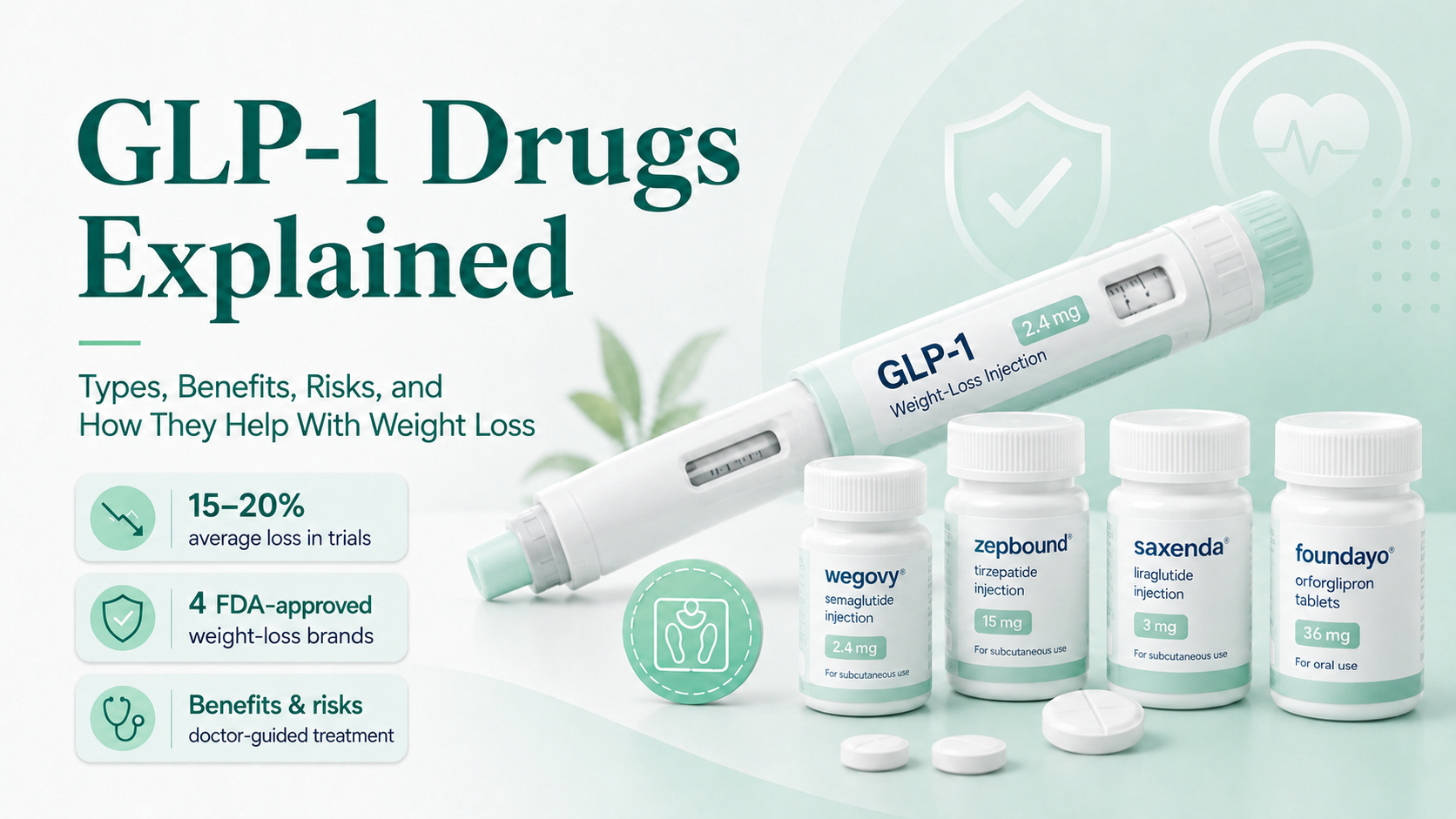
GLP-1 Drugs Explained: Types, Benefits, Risks, and How They Help With Weight Loss
The most effective FDA-approved GLP-1 drugs deliver average weight loss of 15% to 20%, rivaling bariatric surgery. But social media is a minefield of misinformation, illegal products, and brand-name confusion. Here’s the evidence-based breakdown of how they work, which are approved for weight loss, and the risks no one’s mentioning.
In large clinical trials, the most effective FDA-approved GLP-1 drugs produced average weight losses of 15% to 20% — numbers that rival bariatric surgery. Yet the online conversation is a mess of brand-name swapping, inflated promises, and a booming gray market. Scroll for five minutes and you’ll see “Ozempic” used as shorthand for a dozen different drugs, or hear someone claim they bought the same thing for a fraction of the price. Neither holds up. Here’s what the evidence says, stripped of the sales pitch.
How GLP‑1 Drugs Produce Weight Loss
GLP‑1 drugs mimic glucagon‑like peptide‑1, a hormone your gut releases after eating. They bind to receptors in the pancreas, gut, and brain to slow stomach emptying, trigger insulin release only when blood sugar is high, and send strong “I’m full” signals to the brain. Together, those effects can cut hunger and calorie intake deeply.
But the molecule matters. Semaglutide and liraglutide are single‑receptor GLP‑1 agonists. Tirzepatide (Mounjaro, Zepbound) also activates GIP receptors, adding another brake on appetite. That dual action often yields larger weight losses in head‑to‑head trials. Retatrutide, still investigational and not FDA‑approved as of July 2026, hits a third receptor (glucagon), potentially driving even bigger reductions. In short: they don’t all work the same way — and the risks aren’t identical either.
Which GLP‑1 Medications Are Approved for Weight Loss?
Only these four brands carry FDA approval for chronic weight management as of mid‑2026:
| Active Ingredient | Brand Name | FDA‑Approved Indication | |------------------|------------|--------------------------| | Semaglutide | Wegovy (injectable since 2021; oral tablet since Dec 2025) | Chronic weight management (injectable approved for ages 12+; oral for adults only); cardiovascular risk reduction | | Tirzepatide | Zepbound (since Nov 2023) | Chronic weight management; moderate‑to‑severe obstructive sleep apnea in adults with obesity | | Liraglutide | Saxenda (since Dec 2014) | Chronic weight management in adults and ages 12+ | | Orforglipron | Foundayo (approved April 2026) | Chronic weight management — once‑daily oral pill |
Every other GLP‑1 brand — Ozempic, Rybelsus, Mounjaro, Victoza, Trulicity, Byetta, Bydureon — is approved only for type 2 diabetes (some also for cardiovascular risk reduction) and not for weight loss. Prescribing one for weight loss is off‑label: legal, but not backed by the same FDA‑reviewed weight‑loss trial data.
Far more dangerous: unapproved peptides sold as “research‑use only.” The FDA has issued dozens of warning letters about illegally marketed, untested products — including lyophilized powders labeled “Semaglutide 5mg” — and counterfeit Ozempic has entered the supply chain. Compounded versions from licensed pharmacies exist under narrow legal exceptions but are not FDA‑approved and carry sterility and dosing risks.
What the Clinical Trials Actually Show About Weight Loss
Skip the viral photos. The numbers that count come from phase‑3 randomized controlled trials.
Semaglutide (Wegovy) produced an average 14.9% body‑weight loss over 68 weeks in adults with obesity (STEP 1), versus 2.4% on placebo. In people with type 2 diabetes (STEP 2), the mean loss was 9.6%.
Tirzepatide (Zepbound) hit up to ~18% average loss at the highest dose tested in SURMOUNT‑1 — roughly 48 pounds. A head‑to‑head study (SURMOUNT‑5) found it superior to semaglutide: a 20.2% average reduction over 72 weeks, compared with 13.7% for semaglutide.
Liraglutide (Saxenda) showed about 4.5% weight loss over one year in non‑diabetic patients and 3.7% in those with diabetes (SCALE trials).
Retatrutide, an investigational drug that cannot be legally prescribed or sold, delivered up to 28.3% body‑weight loss in the 2026 TRIUMPH‑1 trial and 20.8% in obesity with type 2 diabetes. Eli Lilly stresses that no one should take anything claiming to be retatrutide outside a clinical trial. Potential FDA approval is years away (2027 at the earliest).
Rough effectiveness hierarchy: tirzepatide > semaglutide > liraglutide. Dulaglutide (Trulicity) shows less weight reduction and isn’t used primarily for that purpose. None are quick fixes. The trials all involved long‑term use with dietary changes, and weight typically returns when the medication stops.
Benefits Beyond the Scale
Weight loss gets the attention, but these drugs do more than move a number. Cardiovascular‑outcome trials show semaglutide and tirzepatide cut heart attacks and strokes — possibly beyond what weight loss alone would predict. A 2025 meta‑analysis linked them to a lower risk of kidney failure and major kidney events. Zepbound is the first drug approved for moderate‑to‑severe obstructive sleep apnea in adults with obesity (2024). Research also hints at improvements in metabolic‑associated liver disease, though not yet a formal FDA indication.
What to Track and Discuss With a Doctor
Common side effects — nausea, vomiting, diarrhea, constipation, bloating — usually ease after dose adjustments. More serious risks include acute pancreatitis, gallbladder disease, and possible intestinal obstruction (evidence remains mixed). Seek emergency care for severe abdominal pain, persistent vomiting, or a lump in your neck. Both tirzepatide and semaglutide carry a boxed warning for thyroid C‑cell tumors in rodents; no human cases are confirmed, but anyone with a personal or family history of medullary thyroid cancer or MEN2 should avoid these drugs.
If you’re considering a GLP‑1, your doctor should review your cardiovascular, kidney, and thyroid history, any prior pancreatitis, and set realistic expectations. Never source these drugs from unregulated websites. And clarify whether you’re being prescribed an FDA‑approved weight‑loss brand or an off‑label diabetes drug — the evidence base and safety considerations differ.
What the Internet Usually Gets Wrong
The noise online often clouds a few key distinctions.
“Ozempic face” is not a medical diagnosis. The facial hollowing people discuss is facial fat loss from any rapid, significant weight reduction — whether from medication, surgery, or severe calorie restriction. It’s cosmetic, not a drug‑specific side effect.
Anecdotes aren’t clinical proof. A viral transformation photo tells you nothing about average results, side‑effect frequency, or who is a good candidate.
FAQ
What’s the difference between Ozempic and Wegovy?
Both contain semaglutide. Ozempic is approved only for type 2 diabetes. Wegovy is FDA‑approved for chronic weight management and is available as both a weekly injection and a daily oral tablet; your doctor determines which form and dose are appropriate for you.
Can I buy semaglutide online without a prescription?
No. Any website offering injectable semaglutide “for research” is selling an unapproved, illegal product. There is no legal way to get authentic GLP‑1 medications without a prescription.
How much weight can I expect to lose on a GLP‑1?
Clinical trials show average losses of 15–20% of starting weight with the most effective approved drugs (tirzepatide, semaglutide). Individual results vary, and the drugs work best alongside dietary changes and regular physical activity.
Is tirzepatide better than semaglutide for weight loss?
In SURMOUNT‑5, tirzepatide led to a 20.2% average weight loss over 72 weeks, compared with 13.7% for semaglutide. Its dual action on GIP and GLP‑1 receptors generally yields greater average losses, but the best choice depends on your health and how you tolerate each medication.
Does “Ozempic face” go away?
The facial changes reflect fat loss. They may partially reverse if weight is regained, and some people choose cosmetic procedures. It is not a medical emergency.
Are compounded GLP‑1 drugs safe?
Compounded semaglutide or tirzepatide from licensed pharmacies is not FDA‑approved and may lack the same quality controls. The FDA has proposed removing these ingredients from the list of substances that can legally be compounded in outsourcing facilities, citing no clinical need. Using them carries extra risk.
What are the long‑term side effects of GLP‑1 drugs?
Years of real‑world use have not revealed unanticipated major risks beyond those already identified (pancreatitis, gallbladder disease, rare thyroid concerns). Because weight often returns after stopping, many people remain on treatment long‑term, so ongoing monitoring by a doctor is essential.
Disclaimer: This article is for general education only and does not replace medical advice from a licensed healthcare professional.
GLP‑1s Are a Tool, Not a Shortcut
GLP‑1 agonists have redefined what’s possible for weight loss, but they aren’t interchangeable and they aren’t harmless. The best evidence supports significant, sustained losses with FDA‑approved Wegovy and Zepbound — when used with medical supervision and ongoing safety checks. Off‑label diabetes brands rest on weaker data, and the unregulated market is a gamble with no upside. These are powerful tools, not a substitute for knowing the difference between a prescription and a promise.
Diana Gangan
Comments (0)
Be the first to comment on this article.
