
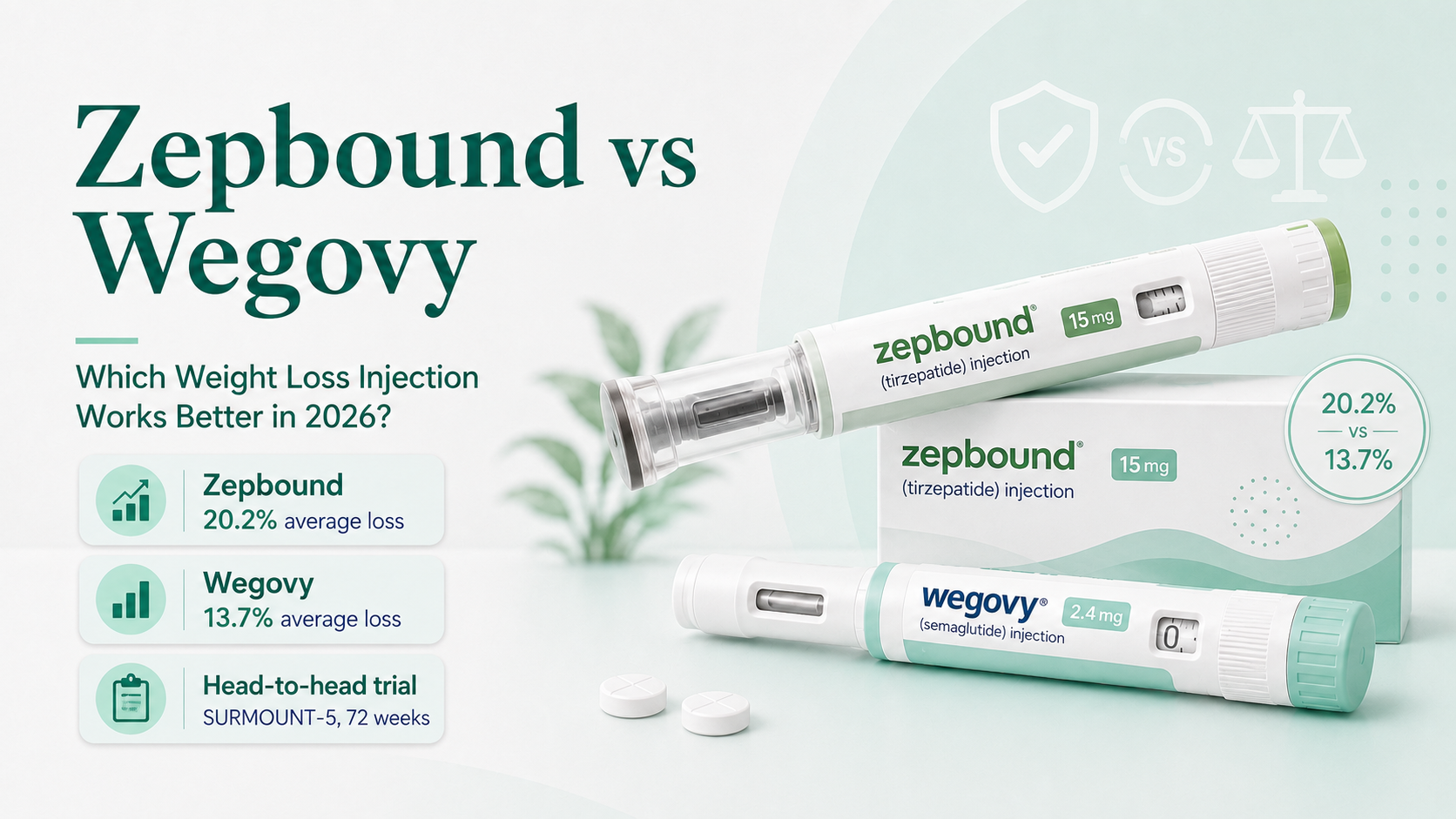
Zepbound vs Wegovy: Which Weight Loss Injection Works Better in 2026?
The first head-to-head trial, SURMOUNT-5, delivered a clear average: Zepbound users lost 20.2% of body weight versus Wegovy’s 13.7% over 72 weeks. But the conversation gets messier once you look past that 47% relative advantage—this was a single industry-funded study, and no independent trial has confirmed the gap.
If you search “Zepbound vs Wegovy,” the only head‑to‑head answer in 2026 is SURMOUNT‑5: adults on Zepbound lost an average of 20.2% of their body weight over 72 weeks, versus 13.7% for those on Wegovy. That’s a 47% relative advantage — but an average says nothing about any one person. Some people on Wegovy lost far more than others on Zepbound. The trial was funded by Zepbound’s manufacturer, and no independent replication exists yet. Meanwhile, Wegovy carries an FDA‑approved label for cardiovascular risk reduction; Zepbound has a unique sleep‑apnea indication. The useful pick depends on your health, not a headline number.
This article is for general education only and does not replace medical advice from a licensed healthcare professional.
Quick Answer: What the Head‑to‑Head Trial Shows
SURMOUNT‑5 tracked 751 adults for 72 weeks. Responder rates: 64.6% of Zepbound users lost at least 15% of their body weight versus 40.1% on Wegovy. A higher proportion on Zepbound reached ≥25% loss, but most participants on either drug did not. The numbers come from a single industry‑funded trial, and there is no head‑to‑head comparison with the newer higher‑dose Wegovy.
What Each Injection Actually Contains
Wegovy’s active ingredient is semaglutide, a GLP‑1 receptor agonist. It mimics a gut hormone that signals fullness, slows stomach emptying, and improves how the body handles blood sugar. A half‑life is the time it takes the body to clear half the dose — semaglutide’s half‑life is about seven days, so one weekly injection maintains steady levels. The drug is started at a low dose and increased gradually under a doctor’s supervision until a maintenance dose is reached.
Zepbound contains tirzepatide, which activates both GLP‑1 and GIP (glucose‑dependent insulinotropic polypeptide) receptors. Researchers suspect the added GIP component may enhance fat‑tissue effects, though a dedicated mechanistic study hasn’t proved it causes the difference. Tirzepatide’s half‑life is roughly five days. Like Wegovy, it begins at a low dose and is slowly raised under medical guidance to the maintenance level.
Both are approved for chronic weight management in adults with a BMI of 30 or higher — or 27 and above with a weight‑related condition — alongside a reduced‑calorie diet and increased physical activity. They are not the same as their diabetes‑labeled siblings: Ozempic (semaglutide) and Mounjaro (tirzepatide) treat type 2 diabetes. Dosing, approval criteria, and insurance coverage differ across brands.
New in 2026: Higher‑Dose Wegovy and Oral Options
The comparison picture sharpened in late 2025 and early 2026. In December 2025, the FDA approved an oral semaglutide tablet for weight management — the first oral GLP‑1 option for obesity. It has its own dosing schedule and hasn’t gone head‑to‑head with Zepbound.
In March 2026, the FDA approved a higher‑dose once‑weekly Wegovy injection. Early analyses presented at the European Congress on Obesity showed that people who tolerated the high dose and lost at least 5% of their starting weight (the trial definition of “responders”) lost nearly 28% of their body weight. No direct comparison with Zepbound exists, so those numbers are an early signal — not a result that settles the debate.
A newer Wegovy indication for fatty‑liver disease (MASH with fibrosis) was approved in August 2025 — something doctors might weigh when treating that condition.
Why a Doctor Might Choose One or the Other
Wegovy has been in use for weight management since 2021, giving roughly five years of real‑world data and a large cardiovascular‑outcome trial (SELECT). As of 2026, it carries an FDA‑approved indication for reducing cardiovascular risk in adults with obesity and established heart disease (approved March 2024) and is indicated for adolescents 12 years and older. Zepbound earned its weight‑management approval in November 2023 and gained a unique indication in December 2024 for moderate‑to‑severe obstructive sleep apnea in adults with obesity.
Because individual response varies unpredictably, your doctor will weigh these indications and your history — not just the average trial gap. No lab test foretells whether you’ll be a strong responder on one and a modest responder on the other.
What the Data Actually Say vs. What You Read on Forums
SURMOUNT‑5 is the only direct comparison between Zepbound and Wegovy. Much of what circulates online stacks numbers from earlier separate trials: Wegovy’s STEP 1 (about 14.9% average loss) and Zepbound’s SURMOUNT‑1 (about 20.9% in the highest‑dose arm). Those trials had different populations, protocols, and placebo arms; treating them as a head‑to‑head is a statistical mistake that survives because it makes a clean story.
Anecdotal forum posts can illustrate what’s possible — extreme loss, tough nausea, sudden plateaus — but they can’t tell you what’s probable. Many first‑person accounts skip the part where stopping the drug usually causes weight regain, a reality documented in clinical trials but often missing from online testimonials.
A Warning About Counterfeit Products
Both Zepbound and Wegovy are brand‑name drugs with no generics. Online sellers may blur the line between FDA‑approved pharmacy products and unregulated “research” peptides. This article covers only FDA‑approved formulations prescribed by a healthcare provider.
What to Discuss with Your Doctor
If you have established heart disease, ask whether Wegovy’s cardiovascular risk‑reduction label applies to your situation. If you carry a sleep‑apnea diagnosis, Zepbound’s unique approval in that area could matter. The newer higher‑dose Wegovy and oral semaglutide option may also enter the conversation, though no head‑to‑head clarity exists yet.
Expect nausea, diarrhea, vomiting, or constipation, especially as the dose increases. Rare but serious events such as pancreatitis or gallbladder disease have been reported with GLP‑1‑based therapies. Both medications carry an FDA boxed warning for thyroid C‑cell tumors — based on rodent studies, with unclear human relevance — and are contraindicated with a personal or family history of medullary thyroid carcinoma or Multiple Endocrine Neoplasia syndrome type 2 (MEN2). Report persistent severe abdominal pain immediately.
Coverage varies widely. Wegovy’s list price was formally reduced in early 2026, and a direct pharmacy option offers it at $499 per month. Zepbound’s list price was not available at the time of writing; manufacturer savings programs exist, so check your plan and the manufacturer’s website. If you’ve already tried one of these medications, your previous experience — both benefits and side effects — can help your doctor weigh whether switching might make sense, but only your doctor can make that decision.
Your doctor will likely monitor weight, waist circumference, blood pressure, blood sugar, and kidney function, and should screen for mental health changes during treatment.
What You’ll Often Read Online (That’s Wrong)
Cross‑trial comparisons aren’t head‑to‑head. Only SURMOUNT‑5 provides a direct comparison; all other percentage claims come from separate studies and can’t be stacked as if they are.
“Ozempic” and “Wegovy” are not interchangeable. Ozempic is semaglutide for type 2 diabetes; Wegovy is semaglutide for weight management. Same active ingredient, different approved uses and dosing. The same applies to Mounjaro vs. Zepbound.
“Ozempic face” or “Zepbound face” isn’t a drug‑specific condition. Rapid weight loss from any method can reduce facial fat, leading to volume loss — a consequence of significant, rapid reduction, not a novel side effect. It may partially improve as weight stabilizes.
The dual mechanism isn’t proven to cause superior weight loss. The GIP component is a strong hypothesis, not established causation. No controlled mechanistic study has isolated its contribution.
One industry‑funded trial doesn’t settle it forever. SURMOUNT‑5 was rigorous and peer‑reviewed, but Eli Lilly funded it. Independent replication remains the gold standard we don’t yet have, and the newer higher‑dose Wegovy adds fresh uncertainty.
Making Sense of the Evidence
Zepbound delivered more average weight loss than Wegovy in the only head‑to‑head trial available in mid‑2026. An average is not a personal guarantee. Wegovy offers longer real‑world experience, a cardiovascular risk‑reduction label, and now a high‑dose version that may narrow the efficacy gap — though no direct trial confirms that yet. The decision isn’t about crowning a winner; it’s a clinical conversation that weighs your medical history, your tolerance for side effects, and what your insurance will actually pay for.
FAQ
Frequently Asked Questions
In the SURMOUNT‑5 head‑to‑head, Zepbound led to a larger average weight loss (20.2% vs. 13.7%) at 72 weeks. That doesn’t mean it’s “stronger” for every individual; some people lose more on Wegovy.
Switching is a medical decision. Doctors sometimes transition patients if one drug is poorly tolerated or weight loss plateaus, but there are no universal switching protocols. Do not stop or change medications without your prescriber’s guidance.
Both cause similar gastrointestinal side effects at comparable rates in clinical trials. In SURMOUNT‑5, 6.1% on Zepbound and 8.0% on Wegovy stopped due to side effects — the trial wasn’t statistically powered to compare tolerability. Individual tolerance varies.
Coverage depends on your plan’s formulary. Many insurers require prior authorization and documented BMI or comorbidity thresholds. Both manufacturers offer savings cards that may reduce out‑of‑pocket costs, but verify directly with your insurer.
Wegovy carries an FDA‑approved indication for cardiovascular risk reduction in adults with obesity and established heart disease, based on the SELECT trial. Zepbound does not have this indication as of mid‑2026, though cardiovascular‑outcome studies are underway.
Mounjaro is the brand name for tirzepatide when used for type 2 diabetes. Zepbound is the same active ingredient but approved for chronic weight management. They are not directly interchangeable without a prescription change.
Clinical trial extension studies show that stopping semaglutide or tirzepatide leads to significant weight regain for most people. The drugs work while you take them; they are not a permanent metabolic reset. Long‑term treatment is usually necessary for sustained effect.
No head‑to‑head trial has compared it with Zepbound. Early data presented in 2026 showed nearly 28% weight loss in people who tolerated the higher dose and lost at least 5% of their starting weight, which may approach Zepbound’s efficacy — but until a direct trial is done, the question remains open.
Diana Gangan
Comments (0)
Be the first to comment on this article.
