
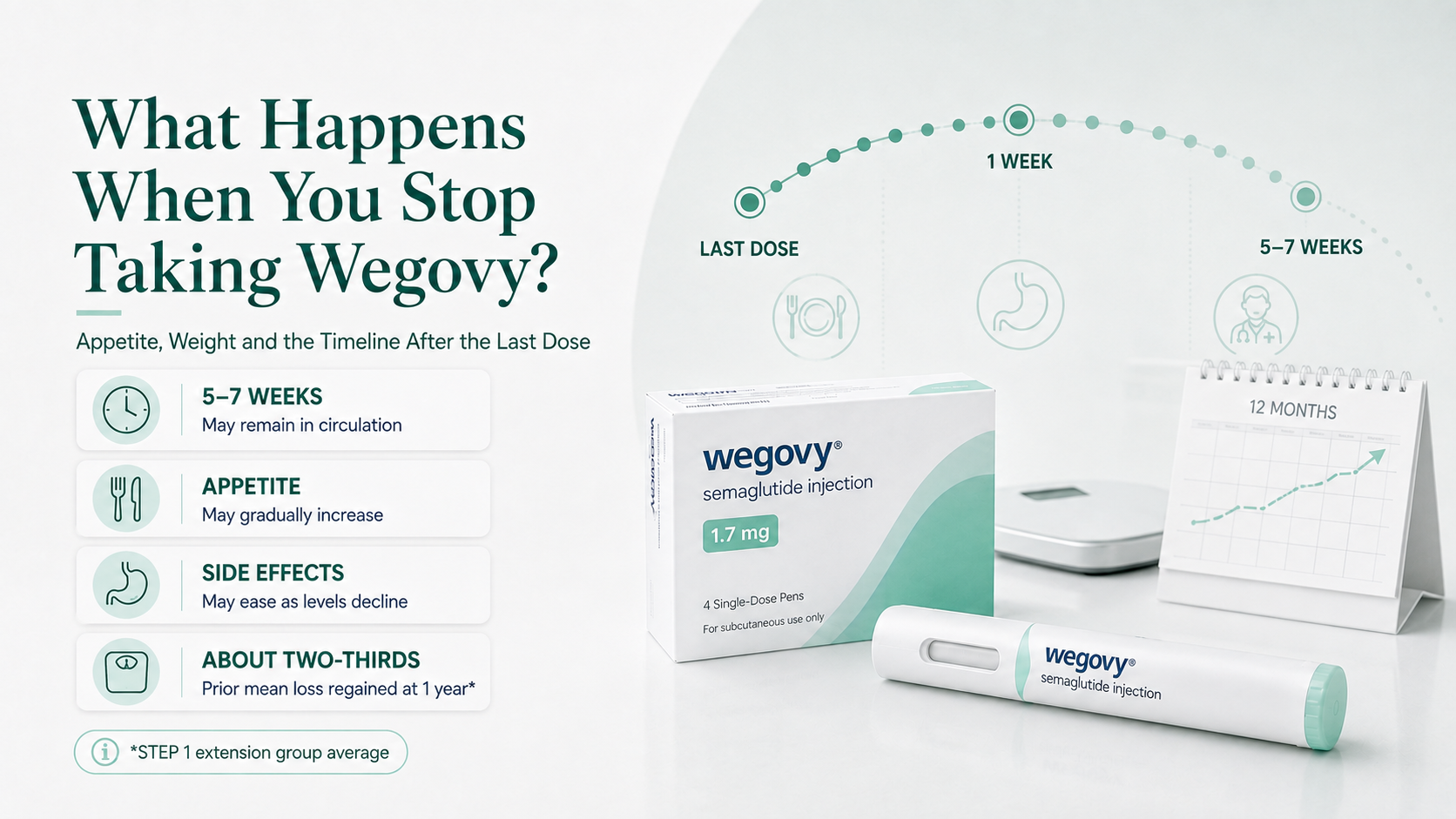
What Happens When You Stop Taking Wegovy?
Wegovy (semaglutide) plays a central role in chronic weight management by regulating appetite and slowing gastric emptying. However, due to changing health goals, financial factors, or persistent Wegovy side effects, many patients eventually consider discontinuing treatment. Understanding how semaglutide clears the body—and what clinical research actually shows regarding appetite changes and long-term weight maintenance—helps set realistic expectations and prepare a structured transition plan with your prescriber.
<strong>Note:</strong> This article primarily discusses once-weekly Wegovy injection and withdrawal evidence involving semaglutide 2.4 mg. Wegovy is also available as oral tablets and in other injectable doses. Individual experiences after stopping may differ.
Quick Answer
After you stop Wegovy, semaglutide levels and effects decline over several weeks. Appetite may increase, digestive side effects may ease, and weight regain is common, although the amount varies. In the STEP 1 extension, participants who stopped injectable semaglutide 2.4 mg and structured lifestyle support regained, on average, about two-thirds of their prior mean weight loss over one year. This was a group average—not a prediction for every patient.
Wegovy (semaglutide) plays a central role in chronic weight management by regulating appetite and slowing gastric emptying. However, due to changing health goals, financial factors, or persistent Wegovy side effects, patients often consider discontinuing treatment and wonder what changes to expect.
Understanding how semaglutide clears the body—and what clinical research actually shows regarding appetite and weight maintenance—helps set realistic expectations and prepare a structured transition plan.
1. How Semaglutide Leaves Your System
Semaglutide has an elimination half-life of approximately <strong>one week</strong>. This means that seven days after your last injection, about half of the medication remains in your bloodstream.
According to the U.S. Prescribing Information for Wegovy:
- 1<strong>Initial Weeks:</strong> Medication levels decrease steadily over the first few weeks, so treatment effects may not disappear immediately.
- 2<strong>5 to 7 Weeks:</strong> Semaglutide <strong>may remain in the circulation for about 5 to 7 weeks</strong> after the last dose.
As circulating semaglutide concentration falls, its biological influence on GLP-1 receptors gradually wanes.
2. Appetite and Digestion After Stopping Wegovy
Because Wegovy works by mimicking the natural GLP-1 hormone—slowing stomach emptying and promoting feelings of fullness—discontinuing the medication leads to progressive metabolic shifts:
- 1<strong>Appetite Changes:</strong> Appetite may gradually increase as the medication’s effects diminish, rather than rebounding instantly on day one.
- 2<strong>Gastric Emptying:</strong> As semaglutide levels fall, its medication-related effect on gastric emptying is expected to diminish. The timing and extent of this change may vary.
- 3<strong>Return of Cravings:</strong> Some people describe a return of cravings or persistent thoughts about food—sometimes called “food noise”—as the appetite-related effects of semaglutide diminish. This experience varies and was not a formal outcome measured in the STEP 1 extension.
Tracking real-world patient reports and Wegovy weight-loss experiences can help frame expectations during this transitional period.
3. Weight Trajectory After Discontinuing Treatment
Weight regain is common after stopping Wegovy, but it is not inevitable, and the amount varies from person to person. In the STEP 1 extension, participants who stopped injectable semaglutide 2.4 mg regained, on average, about two-thirds of their prior mean weight loss over the following year.
Clinical Trial Evidence: STEP 1 Trial Extension & STEP 4
It is vital to interpret trial findings in context. In the <strong>STEP 1 trial extension</strong> (an exploratory analysis of 327 participants), both the medication <strong>and</strong> structured lifestyle interventions were stopped simultaneously:
Metric
STEP 1 Extension Result
<strong>Mean weight change during 68 weeks of treatment</strong>
−17.3% from baseline
<strong>Mean change during the year after withdrawal</strong>
+11.6 percentage points
<strong>Share of prior mean weight loss regained</strong>
About two-thirds on average
<strong>Mean net change at week 120</strong>
−5.6% from baseline
<strong>Cardiometabolic measures</strong>
Most moved toward baseline, although some improvements remained
The <strong>STEP 4 trial</strong> further highlights treatment persistence: participants who switched from semaglutide to a placebo regained an average of 6.9% of body weight over 48 weeks, whereas those who continued semaglutide lost an additional 7.9% (with lifestyle support maintained in both groups).
Key Takeaways:
- 11. <strong>Group Averages vs. Individual Outcomes:</strong> Trial results reflect group averages rather than an exact prediction for every patient. Individual results depend on baseline health, lifestyle habits, and ongoing medical support.
- 22. <strong>Obesity as a Chronic Condition:</strong> Because GLP-1 therapies manage physiological mechanisms rather than permanently altering underlying biology, discontinuing treatment removes the biological support mechanism.
- 33. <strong>Cardiometabolic Shifts:</strong> In the STEP 1 extension, some cardiometabolic improvements remained at one year, despite partial weight regain. Learn more about long-term considerations in our guide on long-term GLP-1 side effects.
4. How to Approach Discontinuation Safely
Talk With Your Prescriber
The current U.S. prescribing information does not provide a standard tapering schedule for stopping Wegovy. However, you should discuss discontinuation with your prescriber so that appetite, weight, blood glucose, and any related health conditions can be monitored.
If treatment has only been interrupted due to missed shots or supply delays, follow the current missed-dose instructions rather than restarting the previous dose on your own. See the Wegovy dosing schedule for additional context.
Personalize Nutrition and Activity
Because baseline metabolic rates and nutritional requirements differ, lifestyle plans should be individualized in consultation with a healthcare provider or registered dietitian:
- 1<strong>Protein and Fiber:</strong> Focus on dietary fiber and adequate protein tailored to your personal health status to help sustain natural satiety.
- 2<strong>Resistance Training:</strong> Regular strength training helps maintain lean muscle mass, supporting overall physical health and metabolic function.
- 3<strong>Behavioral Maintenance:</strong> Continuous self-monitoring and routine follow-ups help establish lasting habits after medication withdrawal.
The Bottom Line
Semaglutide levels decline gradually after stopping Wegovy and may remain in the circulation for approximately 5 to 7 weeks. Appetite may increase, some side effects may ease, and weight regain is common—but individual outcomes vary. In the STEP 1 extension, participants regained an average of about two-thirds of their previous mean weight loss over one year. Decisions about stopping, restarting, or switching treatment should be made with a prescriber.
Sources
- 1Wegovy U.S. Prescribing Information
- 2Weight Regain and Cardiometabolic Effects After Withdrawal of Semaglutide: The STEP 1 Trial Extension
- 3Effect of Continued Weekly Semaglutide vs Placebo: The STEP 4 Trial
Diana Gangan
Comments (0)
Be the first to comment on this article.
