
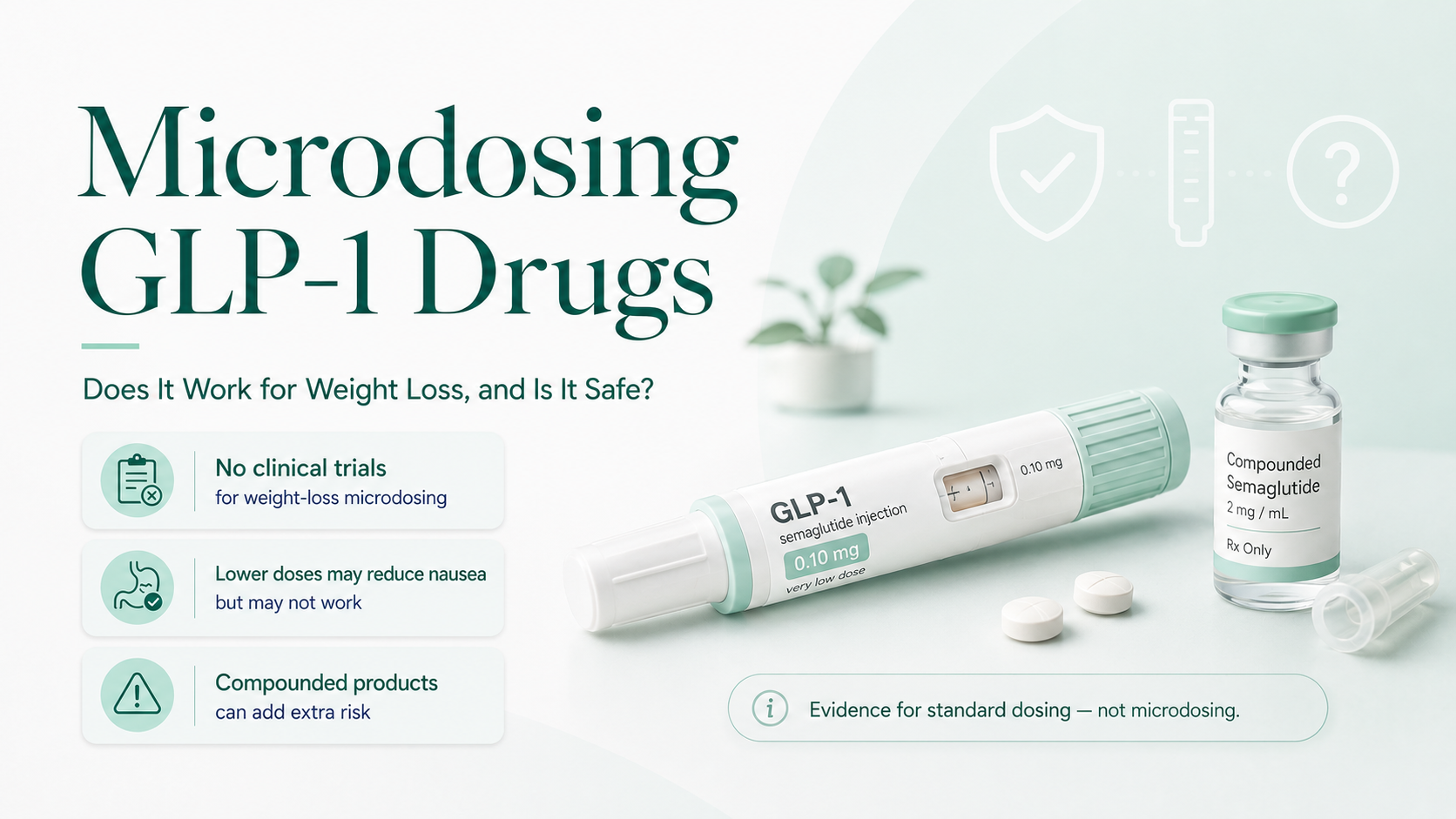
Microdosing GLP-1 Drugs: Does It Work for Weight Loss, and Is It Safe?
Microdosing GLP-1 drugs is popular, but no clinical trials support its weight loss effects. Uncover the safety risks, the role of compounded meds, and why standard dosing works.
Microdosing GLP-1 Drugs: Does It Work for Weight Loss, and Is It Safe?
Spend enough time on weight‑loss forums and you’ll encounter microdosing — a tiny fraction of an Ozempic or Wegovy dose, usually paired with a three‑part promise: you’ll still lose weight, skip the nausea, and spend less. Online influencers describe it with the certainty of people who’ve cracked a secret code. The catch? Nobody has studied it.
Quick Answer: Does Microdosing GLP‑1 Work?
No published clinical trial has tested microdosing a GLP‑1 drug for weight loss. All proven benefits — including the 15% average body‑weight reduction in the STEP‑1 trial — come from doses at or above the manufacturer’s recommended starting dose, reached under medical supervision. Staying below that threshold might do something, might do nothing; the evidence doesn’t say.
Safety at these unstudied doses is also unknown, and many who try it are using compounded products that aren’t FDA‑approved and may carry additional risks.
How GLP‑1 Drugs Control Hunger — and Why Dose Matters
GLP‑1 receptor agonists copy a hormone your gut releases after eating. That hormone tells the pancreas to release insulin, the liver to slow glucose production, slows stomach emptying, and acts on appetite centers in the brain. You feel full sooner, for longer, and food stops occupying so much mental real estate.
Semaglutide (Wegovy, Ozempic) and tirzepatide (Zepbound, Mounjaro) amplify those signals. Tirzepatide also hits GIP receptors — GIP is another gut hormone that amplifies insulin release and may affect fat metabolism — which may explain the larger average weight loss seen in its trials.
The standard prescription approach raises the dose gradually so the body adapts, eventually reaching a level proven effective in large studies. The logic behind an even smaller dose seems intuitive: if a little works, maybe a lot less still does something with fewer side effects. It’s a sensible guess. It’s also wrong about how often biology runs on straight lines.
Why the Source of Your GLP‑1 Matters
Microdosing gained traction partly through the compounding pharmacy ecosystem. When brand‑name GLP‑1 drugs land on the FDA shortage list, certain compounding pharmacies and telehealth startups can legally prepare them. Some began marketing “microdosed” semaglutide or tirzepatide — often implying weight loss without the misery, at a lower monthly cost.
Those compounded products are not FDA‑approved. The FDA has warned that compounded formulations, especially those using salt forms like semaglutide sodium, have not been tested for safety or efficacy, and raised concerns about contamination, incorrect dosing, and sterility[^1].
So when someone online claims they’re “microdosing,” ask what exactly they’re injecting. An FDA‑approved pen at a below‑standard click count? A compounded liquid from a telehealth company? A vial of research‑grade powder reconstituted at home? One resembles a prescribed medicine; the others are closer to a chemistry experiment you run on yourself.
Clinical Data vs. Forum Anecdotes
The approved weight‑loss trials for semaglutide (STEP) and tirzepatide (SURMOUNT) tested specific dose escalations. In STEP‑1, participants on semaglutide 2.4 mg lost an average of roughly 15% of their body weight[^2] — but only after a supervised ramp‑up. The starting dose was never designed as a long‑term maintenance treatment.
As of mid‑2026, no published clinical trial has put microdosing to the test. Online anecdotes feature people claiming success, but they’re riddled with survivorship bias: people who see no effect tend to stop posting. You can’t know what fraction of microdosers get zero benefit, or actually regain weight because appetite suppression never kicked in.
One pattern is consistent: gastrointestinal side effects — nausea, vomiting, diarrhea, constipation — are dose‑dependent. Lower doses typically reduce symptoms but don’t eliminate them. Some people feel unwell even at very low exposure.
What to Track and Discuss With a Doctor
Because microdosing sits outside the evidence, a doctor conversation needs to go beyond dose size. Clarify exactly what you’re injecting — an FDA‑approved brand, a compounded product, or something else — and the actual milligram dose, not just a label. Report any GI symptoms, bowel changes, or signs of dehydration. Track weight changes and discuss whether the loss is safe and sustainable. Ask specifically about gallbladder problems and pancreatitis risk. Mention the thyroid C‑cell tumor risk: all GLP‑1 drugs carry a boxed warning because rodent studies showed a potential concern; they are contraindicated in people with a personal or family history of medullary thyroid carcinoma (MTC) or Multiple Endocrine Neoplasia syndrome type 2 (MEN 2). The human relevance is unproven, but the warning exists for a reason. Seek immediate medical attention for sudden severe abdominal pain, unstoppable vomiting, or signs of an allergic reaction — regardless of dose size.
What the Internet Gets Wrong
Social media has turned cautious clinical titration into a wellness trend, and several myths now circulate as fact.
- 1“Microdosing eliminates side effects.” Lower doses often reduce GI symptoms but don’t erase them. Some people still feel sick on tiny amounts.
- 2“A microdose works just as well, only slower.” No evidence shows that staying permanently below the starting dose triggers meaningful appetite suppression. Below a certain threshold, the drug may do nothing at all.
- 3“Ozempic face” is a drug‑specific reaction. It isn’t. Rapid fat loss from any cause can change facial appearance. The nickname describes a weight‑loss effect, not a semaglutide‑specific toxicity.
- 4“Compounded microdose versions are identical to the real thing.” FDA warnings about salt forms and quality control make clear they are not[^1]. Some products contain ingredients never studied in humans.
- 5“Doctors push high doses to make money.” Titration schedules exist because they were tested and shown to work. Starting doses were never studied as standalone maintenance therapy; that’s not a financial incentive, it’s a scientific one.
The Bottom Line
If you’re considering microdosing, the most important question isn’t “Will it work?” but “What exactly am I injecting?” When the source and dose are both unverified, you’re not a pioneer; you’re an unpaid test subject for a strategy nobody studied.
FAQ
Frequently Asked Questions
Possibly for GI side effects, since they are dose‑dependent. But no trial has measured long‑term safety at these low doses, and using unregulated products adds risks unrelated to dose size.
Some telehealth companies advertise it, but compounded products aren’t FDA‑approved. The FDA warns about salt forms and sterility issues. Dose accuracy isn’t independently verified.
Because it hasn’t been studied. Medical guidelines rest on clinical trial evidence, and none exists for staying permanently below the starting dose.
Using an approved pen at a low click count can stretch one pen across many weeks, lowering monthly cost — but only if the dose actually helps. Compounded options often charge less but come with unknown quality.
No. The manufacturer’s starting dose is a temporary step in a supervised titration schedule meant to reach a therapeutic level. Microdosing proposes staying below that step indefinitely.
[^1]: U.S. Food and Drug Administration. Compounded Semaglutide and Tirzepatide Products: Information for Patients and Health Care Professionals. https://www.fda.gov/drugs/postmarket-drug-safety-information-patients-and-providers/compounded-semaglutide-and-tirzepatide-products-information (accessed July 25, 2026).
[^2]: Wilding JPH, et al. Once‑Weekly Semaglutide in Adults with Overweight or Obesity. N Engl J Med. 2021;384:989‑1002. https://doi.org/10.1056/NEJMoa2032183.
Diana Gangan
Comments (0)
Be the first to comment on this article.
