
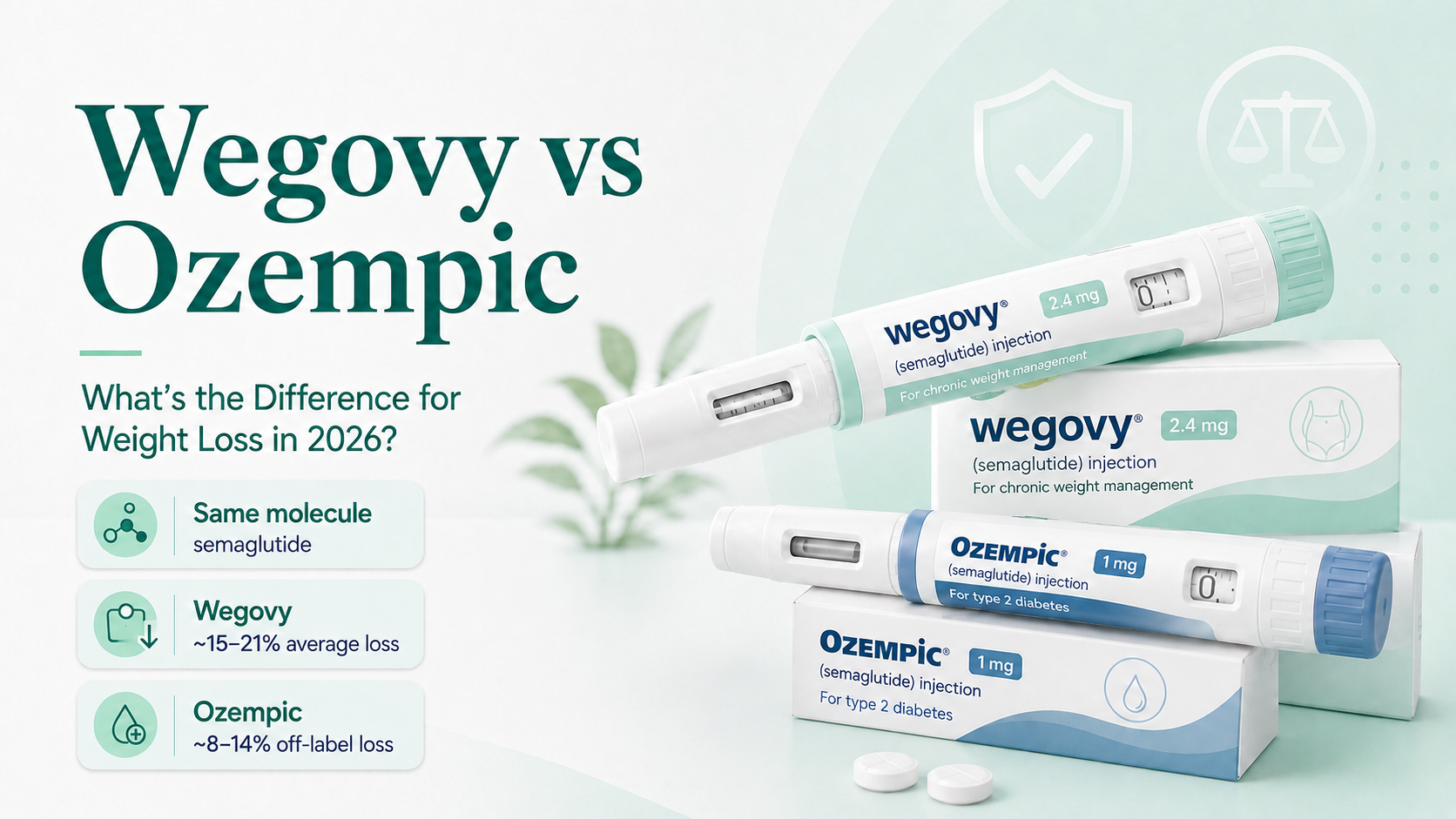
Wegovy vs Ozempic: What’s the Difference for Weight Loss in 2026?
Scroll through any weight-loss forum and you’ll see Wegovy and Ozempic used interchangeably — but in 2026, the lines are sharper than ever. They’re the same molecule, semaglutide, yet one is purpose-built for obesity while the other treats diabetes, and a new Costco cash-pay program levels the price so the only remaining factor is which FDA approval matches your health goal.
Wegovy vs Ozempic isn’t a choice between two drugs. It’s a choice between two FDA‑approved purposes for a single molecule: semaglutide. Online, the names blur together — in weight‑loss testimonials, celebrity gossip, and side‑effect horror stories alike. The pens look alike, the active ingredient is identical, and until recently a price gap pushed many toward off‑label Ozempic. In 2026, that’s changed. New high‑dose injections, new daily pills, and a Costco cash‑pay program that flat‑rates both brands mean the real question is no longer cost. It’s whether you’re treating diabetes or obesity — and which label was built for that job.
Quick Answer
- 1Wegovy is FDA‑approved for chronic weight management. Options: a once‑weekly injection at 2.4 mg or high‑dose 7.2 mg, or a 25 mg daily pill.
- 2Ozempic is approved only for type 2 diabetes and related heart/kidney protection. Maximum injection dose: 2.0 mg once weekly. Oral Ozempic tablets top out at 9 mg per day.
Off‑label Ozempic for weight loss, at those lower diabetes doses, yields an average reduction of roughly 8–14% of starting weight. Wegovy’s obesity‑calibrated doses deliver mean reductions of roughly 15–21%. Costco’s cash‑pay program now prices both injectables at $499 a month — cost no longer forces anyone toward one name over the other.
One Molecule, Two Paths
Both brands contain semaglutide, a synthetic version of the gut hormone GLP‑1. After you eat, GLP‑1 tells the pancreas to release insulin, tells the brain you’re full, and slows stomach emptying. Semaglutide resists rapid breakdown, so a single weekly injection lasts.
Novo Nordisk dosed Wegovy for weight loss and Ozempic for diabetes. The molecule is the same, but the approved doses — and the clinical evidence — are not.
In 2026, Wegovy expanded: a 7.2 mg injection arrived in March, and a 25 mg oral tablet was approved in December 2025. Ozempic also gained reformulated oral tablets (1.5, 4, and 9 mg), formerly sold as Rybelsus (R2 formulation) and now rebranded under the Ozempic name — still diabetes‑only. The original Rybelsus tablets (3, 7, and 14 mg) remain a separate product.
Weight Loss: The Trial Numbers
All numbers below come from large randomized controlled trials.
Wegovy 2.4 mg injection (STEP trials) In the STEP 1 trial, published in the New England Journal of Medicine in 2021, 1,961 adults without diabetes lost an average 14.9% of their body weight at 68 weeks, versus 2.4% on placebo. 86% lost at least 5%. Across several STEP studies, mean losses in people without diabetes ranged from 14.9% to 17.4%.
Wegovy HD 7.2 mg (STEP UP) Average loss hit 20.7% at 72 weeks; about one in three lost 25% or more. Even in people with both obesity and type 2 diabetes, the STEP UP T2D trial showed a mean loss of 13.2–14.1%.
Wegovy oral 25 mg (OASIS 4) When taken daily as directed, the pill produced a mean loss of 16.6% at 64 weeks. A more conservative treatment‑policy estimand from the same trial landed at 13.6%.
Ozempic for weight loss (off‑label) Ozempic’s diabetes‑focused trials studied doses up to 2.0 mg. Weight loss in those studies fell in the 8–14% range — substantial, but smaller than what purpose‑built Wegovy doses deliver.
The Costco Program: No More Price Gap
For years, insurance drove people toward off‑label Ozempic. Many plans covered the diabetes brand but refused weight‑loss drugs. That changed in October 2025, when Costco and Novo Nordisk launched a member cash‑pay program.
Through the Costco Member Prescription Program, a 4‑week supply of injectable Ozempic or Wegovy costs $499 for members who pay without insurance. Even sharper pricing exists through Costco’s partner Sesame — $349/month for injectables — and Novo Nordisk’s own pharmacy offers the Wegovy pill as low as 49/month for starter doses.
These are cash‑pay discounts. You cannot combine them with Medicare, Medicaid, or private insurance claims. Without any program, list price still hovers near ,349 a month. But the price gap was the last reason to settle for a diabetes dose when what you wanted was weight loss. That reason is gone.
What People Get Wrong Online
“Ozempic is a weight‑loss drug.” It isn’t. Ozempic is approved only for type 2 diabetes. Weight loss is a side effect — not the therapeutic target — and its maximum dose reflects diabetes management, not obesity. Wegovy is the FDA‑approved obesity treatment. Confusing the two can leave you on a lower, diabetes‑capped dose.
“They’re exactly the same.” Same molecule, different purposes. Wegovy injectors are single‑use; Ozempic pens are multi‑dose. The approved dosing caps differ significantly. These design choices matter in the exam room and at the pharmacy.
“Ozempic face” is a medical condition. No such diagnosis exists. Loss of facial fat can accompany any substantial weight loss — surgery, diet, medication. It’s not a semaglutide‑specific phenomenon, and the drug doesn’t directly cause it.
“Compounded semaglutide is still a valid cheaper option.” The FDA declared the semaglutide injection shortage resolved in February 2025. As of mid‑2026, large‑scale compounding is no longer legally permitted. Cost alone is not a medically valid reason to seek an unregulated product, and compounded drugs are not FDA‑reviewed for safety or quality.
“Rybelsus and the new Ozempic tablets are the same.” They’re not. The original Rybelsus (3, 7, 14 mg) uses an older absorption technology. The reformulated Ozempic tablets (1.5, 4, 9 mg) are a different product with different bioavailability. They are not mg‑for‑mg interchangeable.
What to Track and Discuss With a Doctor
Because both drugs share the same active ingredient, side‑effect profiles overlap. Nausea, vomiting, diarrhea, and constipation are common — especially during early weeks and dose increases. More serious but rare risks include pancreatitis, gallbladder disease, and a type of medullary thyroid tumor observed in rodent studies (not confirmed in humans). The FDA label carries a boxed warning about these tumors; semaglutide is not recommended during pregnancy.
Call your doctor immediately if you notice a lump or swelling in your neck, persistent hoarseness, trouble swallowing, or shortness of breath — these could signal a thyroid tumor. Also seek urgent care for severe stomach pain that doesn’t let up, a racing heartbeat, or signs of gallbladder trouble like yellowing skin or clay‑colored stools.
Dose increases must happen under medical oversight. Before you start, mention any personal or family history of thyroid cancer or pancreatitis. And because many insurers still treat obesity medications differently from diabetes drugs, ask whether a weight‑related comorbidity — high blood pressure, sleep apnea, or type 2 diabetes — will affect Wegovy coverage.
Bottom Line
Wegovy and Ozempic share semaglutide but serve different clinical goals. For weight loss, Wegovy is the tool — its doses, trial data, and 2026 lineup were built for that job. Ozempic treats diabetes and can cause weight loss, but it was never calibrated for obesity. Costco’s cash‑pay pricing erased the old financial barrier. The decision now hinges on one question: are you treating diabetes, or obesity? That distinction, not the brand name, drives the results.
FAQ
Frequently Asked Questions
Yes. Wegovy’s approved doses sit above Ozempic’s 2.0 mg maximum, and clinical trials consistently show larger mean weight reductions from those obesity‑specific doses.
Only with a doctor’s off‑label prescription. Ozempic is not FDA‑approved for weight loss, and its maximum dose is lower than what was studied and cleared for obesity. Talk to your doctor about which option fits your situation.
Yes. The Costco Member Prescription Program launched in October 2025, offering both injectable brands at $499 per 4‑week supply for Costco members paying without insurance. Partner pricing through Sesame and NovoCare can be even lower for some formulations.
Yes. The FDA approved Wegovy oral tablets (25 mg/day) in December 2025 specifically for chronic weight management. They are the only oral semaglutide with a weight‑loss indication.
Some plans cover Ozempic for type 2 diabetes but exclude Wegovy for weight loss. You and your doctor will need to weigh the clinical difference against the out‑of‑pocket cost. Costco’s cash‑pay options may close that gap.
Many patients titrate up on semaglutide before reaching a maintenance dose, but switching brands and dosing schedules must be decided by your doctor. Wegovy’s obesity‑specific doses are not interchangeable with Ozempic’s diabetes‑capped doses, so a direct conversation about your long‑term weight‑loss goal is essential.
This article is for general education only and does not replace medical advice from a licensed healthcare professional.
Diana Gangan
Comments (0)
Be the first to comment on this article.
