
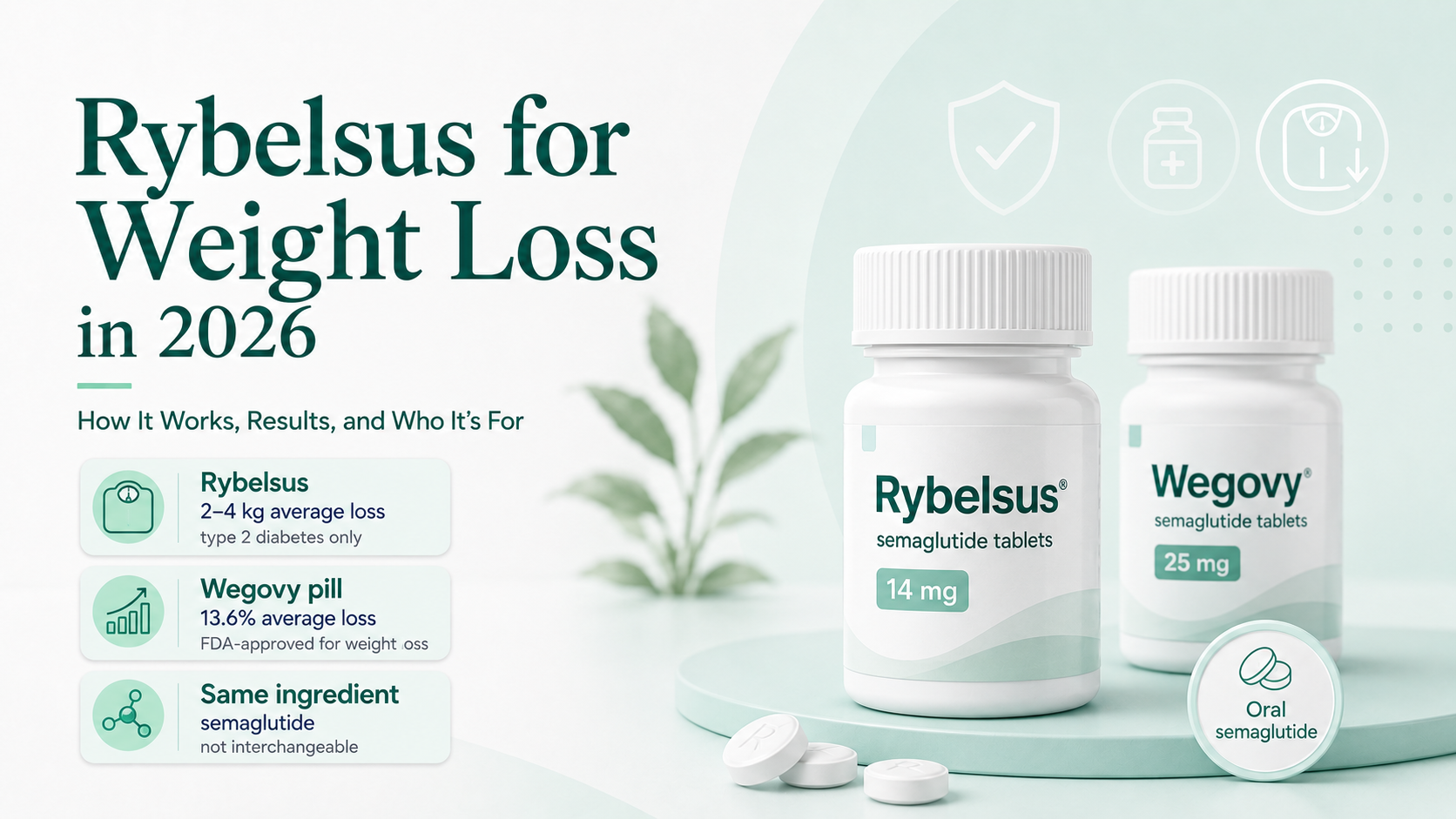
Rybelsus for Weight Loss in 2026: How It Works, Results, and Who It’s For
If you’ve searched for “Rybelsus for weight loss,” you’ve likely stumbled into a tangle of outdated articles, brand-name confusion, and claims that belong to an entirely different pill. Novo Nordisk’s flurry of rebranding and new launches has muddied the waters so thoroughly that even doctors misstep—but a straight answer exists once you know which oral semaglutide you’re actually holding.
Search “rybelsus for weight loss” and you land on outdated articles, brand chaos, and claims that belong to a different product entirely. Over the past year, Novo Nordisk renamed products, launched new ones — and created enough confusion that even doctors stumble. You want a straight answer: Does this pill do anything for weight loss? The answer depends entirely on which pill you’re holding.
This article is for general education only and does not replace medical advice from a licensed healthcare professional.
Quick Answer: Is Rybelsus a Weight-Loss Drug?
Rybelsus is not a weight-loss drug. It’s approved only for adults with type 2 diabetes — and, since late 2025, for lowering cardiovascular risk in that same group.
Weight loss does happen, but it’s a secondary effect: about 2 to 4 kilograms (4 to 9 pounds) in people taking it for diabetes. The trials that measured this only included people who already had diabetes, and weight loss was never the main goal of those studies. If weight loss is your primary aim, the only FDA-approved oral semaglutide pill is the Wegovy pill (25 mg) — a different brand, with a different dose and indication, even though the active ingredient is the same. Most of the chatter is really about the Wegovy pill — or outdated info, or wishful off‑label thinking.
How Does Oral Semaglutide Actually Work — and Why Are the Dosing Rules So Strict?
Semaglutide is a GLP-1 receptor agonist. It mimics a gut hormone that tells your pancreas to release insulin when blood sugar rises, signals your liver to produce less sugar, slows stomach emptying, and — critically — dials down appetite in the brain.
Turning semaglutide into a pill is tricky because peptides are normally destroyed in the stomach before they can reach the bloodstream. Rybelsus and Ozempic tablets both use a technology called SNAC (salcaprozate sodium). SNAC temporarily alters the stomach lining so the semaglutide molecule can slip through the stomach wall. Without it, absorption would be near zero. That’s why the dosing instructions are so strict: take the tablet on an empty stomach with no more than 4 ounces of plain water, then wait at least 30 minutes before eating, drinking, or taking any other oral medication. The Wegovy pill uses a similar approach, although its exact formulation is not publicly described in the same detail.
Rybelus, Ozempic tablets, and the Wegovy pill all contain semaglutide, but they are not interchangeable. A given milligram dose of one brand is not equivalent to the same numeric dose of another — the formulations differ and are not dose‑for‑dose swappable.
The Weight-Loss Evidence: What the Trials Actually Show
Rybelsus (R1 formulation, 14 mg) — PIONEER trials In large Phase 3 trials of people with type 2 diabetes, Rybelsus 14 mg produced average weight loss of roughly 2 to 4 kg (4 to 9 lb) over about six months. In the PIONEER 4 study, weight dropped 4.4 kg over 26 weeks when added to metformin. These are real, measurable changes, but weight loss was a secondary endpoint — the trials were designed to prove blood‑sugar control, not weight loss. The numbers are modest compared to dedicated obesity medications.
Wegovy pill (oral semaglutide 25 mg) — OASIS 4 trial This is the pivotal trial that led to the FDA approving the Wegovy pill for chronic weight management. In a 64‑week study of 307 adults with obesity or overweight (without diabetes), oral semaglutide 25 mg led to a mean 13.6% reduction in body weight, while the placebo group lost just 2.4%. Around 80% of participants lost at least 5% of their starting weight, roughly 50% lost 15% or more, and about 30% lost 20% or more.
An older study — OASIS 1 — tested an even higher 50 mg oral semaglutide dose and saw 15.1% weight loss over 68 weeks. That dose is investigational; no approved product uses it. If you see someone claiming Rybelsus produces 15% weight loss, they are almost certainly quoting that unapproved dose or confusing Rybelsus with the Wegovy pill.
The bottom line: Rybelsus’s weight loss is real but modest and was observed only in a diabetic population. The substantial numbers come from Wegovy, not Rybelsus.
Rybelsus vs. Wegovy Pill: Why the Brand Name Matters
In 2026, the naming landscape is so tangled that even healthcare professionals get tripped up. Here’s a clear map:
| Brand (current as of July 2026) | Formulation | Doses | FDA-Approved For | |-----------------------------------|---------------------|------------------------------|--------------------------------------| | Rybelsus | R1 (original) | 3 mg, 7 mg, 14 mg | Type 2 diabetes; CV risk reduction | | Ozempic tablets | R2 (formerly called Rybelsus R2) | 1.5 mg, 4 mg, 9 mg | Type 2 diabetes; CV risk reduction | | Wegovy pill | Dedicated weight‑loss tablet | 1.5 mg, 4 mg, 9 mg, 25 mg | Chronic weight management; CV risk reduction in obesity/overweight | | Wegovy injection | Injectable pen | 2.4 mg/week | Chronic weight management |
The 1.5 mg, 4 mg, and 9 mg doses are part of a 12‑week dose‑escalation schedule; the 25 mg maintenance dose is the one that produced the 13.6% weight loss in OASIS 4.
In January 2026, Novo Nordisk rebranded the R2 formulation from “Rybelsus R2” to Ozempic tablets — still a diabetes‑only product. The original Rybelsus kept its name but only for the 3/7/14 mg doses. The Wegovy pill launched in early January 2026 and is the only oral semaglutide product approved specifically for weight loss.
This rebranding creates a trap for anyone Googling “rybelsus for weight loss.” Many articles written before mid‑2025 will tell you “Rybelsus is the oral version of Ozempic” and imply you can use it for weight loss. That was never accurate, and in 2026 it’s more misleading than ever.
What to Discuss with a Doctor if Weight Loss Is Your Goal
If you’re living with type 2 diabetes and also want to lose weight, Rybelsus might come up — not as a weight‑loss drug, but because the modest weight reduction seen in trials is a welcome secondary effect. You’d still be taking it for diabetes, under its approved indication.
If you don’t have diabetes but want an oral GLP‑1 for weight loss, the FDA‑approved path is the Wegovy pill (25 mg). It requires a prescription based on BMI criteria (obesity, or overweight with a related health condition) and is meant to be used alongside diet and exercise. Any off‑label use of Rybelsus for this purpose means there are no official dosing guidelines, no long‑term safety data in that population, and typically no insurance coverage.
When speaking with a doctor, be direct about your history. If you’ve ever had pancreatitis, gallbladder trouble, or a family history of medullary thyroid cancer, say so — oral semaglutide can make those conditions dangerous. Mention any other oral medications you take because the mandatory fasting window can change how some drugs are absorbed. And if you develop severe stomach pain, persistent vomiting, or signs of an allergic reaction, get urgent medical attention immediately.
Your doctor will typically monitor your weight, kidney function, and any gastrointestinal side effects. In trials of the weight‑loss dose, nausea affected nearly half of people and vomiting about 30%. These effects are usually temporary but can be severe for some.
What the Internet Gets Wrong
- 1“Rybelsus is the oral version of Wegovy for weight loss.” Wrong. The oral weight‑loss pill is Wegovy, which goes up to 25 mg. Rybelsus maxes out at 14 mg and is a diabetes drug.
- 1“Rybelsus is FDA‑approved for weight loss.” It is not. As of July 2026, the only oral GLP‑1 approved for chronic weight management is Wegovy. Online forums and influencer posts frequently misstate this.
- 1Pointing to the 50 mg trial as proof Rybelsus works wonders. That dose is investigational and was tested in OASIS 1, a study unrelated to any Rybelsus trial. The approved 14 mg dose doesn’t come close.
- 1Treating all oral semaglutide as interchangeable. The R1, R2, and Wegovy formulations have different bioavailability. The FDA explicitly warns against swapping one for another dose‑for‑dose. Substituting the Wegovy pill for Rybelsus won’t give you the same effect.
- 1Relying on outdated articles that still mention “Rybelsus R2.” That name hasn’t existed since January 30, 2026. It’s now Ozempic tablets — and still not for weight loss. Pharmacy systems and search results are catching up, so verify what you’re reading.
- 1Confusing the source of dramatic weight‑loss anecdotes. Many “Rybelsus success stories” actually involve the Wegovy pill, off‑label dosing, or compounded versions that don’t match the approved product. Anecdotes aren’t a substitute for clinical trial data.
Bottom Line
In 2026, typing “rybelsus for weight loss” into a search bar hands you a tangle of dead names and borrowed data. The pill most people are actually looking for is the Wegovy pill, which is FDA‑approved for weight loss and delivers meaningful results in clinical trials. Rybelsus does its job for diabetes, but asking it to act like a weight‑loss drug sets up a letdown. If you’re considering an oral GLP‑1 for weight management, the conversation with your doctor should start with Wegovy — not Rybelsus.
FAQ: Rybelsus and Weight Loss in 2026
Frequently Asked Questions
There are no long‑term safety studies of Rybelsus in people without diabetes. Using it off‑label means no established dosing guidelines, no evidence of lasting benefit for weight loss, and likely no insurance coverage. The approved oral weight‑loss option is the Wegovy pill, which has been specifically studied in this population.
Both contain semaglutide, but they are different brands with different approved doses and indications. Rybelsus (max 14 mg) is for type 2 diabetes; the Wegovy pill goes up to 25 mg and is approved for chronic weight management in people with obesity or overweight plus a related condition.
Trials in people with type 2 diabetes show an average loss of about 2 to 4 kg (4 to 9 lb) over roughly six months. It’s a secondary effect during diabetes treatment — not comparable to the weight loss seen with dedicated obesity medications.
As of 2026, the product formerly called “Rybelsus R2” was rebranded as Ozempic tablets (1.5 mg, 4 mg, 9 mg). It remains a diabetes‑only medication. The original Rybelsus (3/7/14 mg) is still sold under the Rybelsus name. Neither is approved for weight loss.
For Rybelsus, nausea, diarrhea, and vomiting are the most commonly reported side effects. At the Wegovy pill (25 mg) dose used for weight management, nearly half of trial participants experienced nausea and about 30% vomiting. Most gastrointestinal side effects are temporary, but persistent vomiting or severe abdominal pain requires urgent medical evaluation.
Many internet posts and older articles were written before the Wegovy pill existed, when Rybelsus was the only oral semaglutide option. Some still confuse the products or deliberately seek off‑label use. Always check the date and the specific product being discussed.
The Wegovy pill (25 mg) produced weight loss on par with injectable Wegovy (2.4 mg) in separate clinical trials. Rybelsus, at its diabetic dose, yields much smaller weight changes and cannot be compared directly to injectable weight‑loss medications.
Diana Gangan
Comments (0)
Be the first to comment on this article.
