
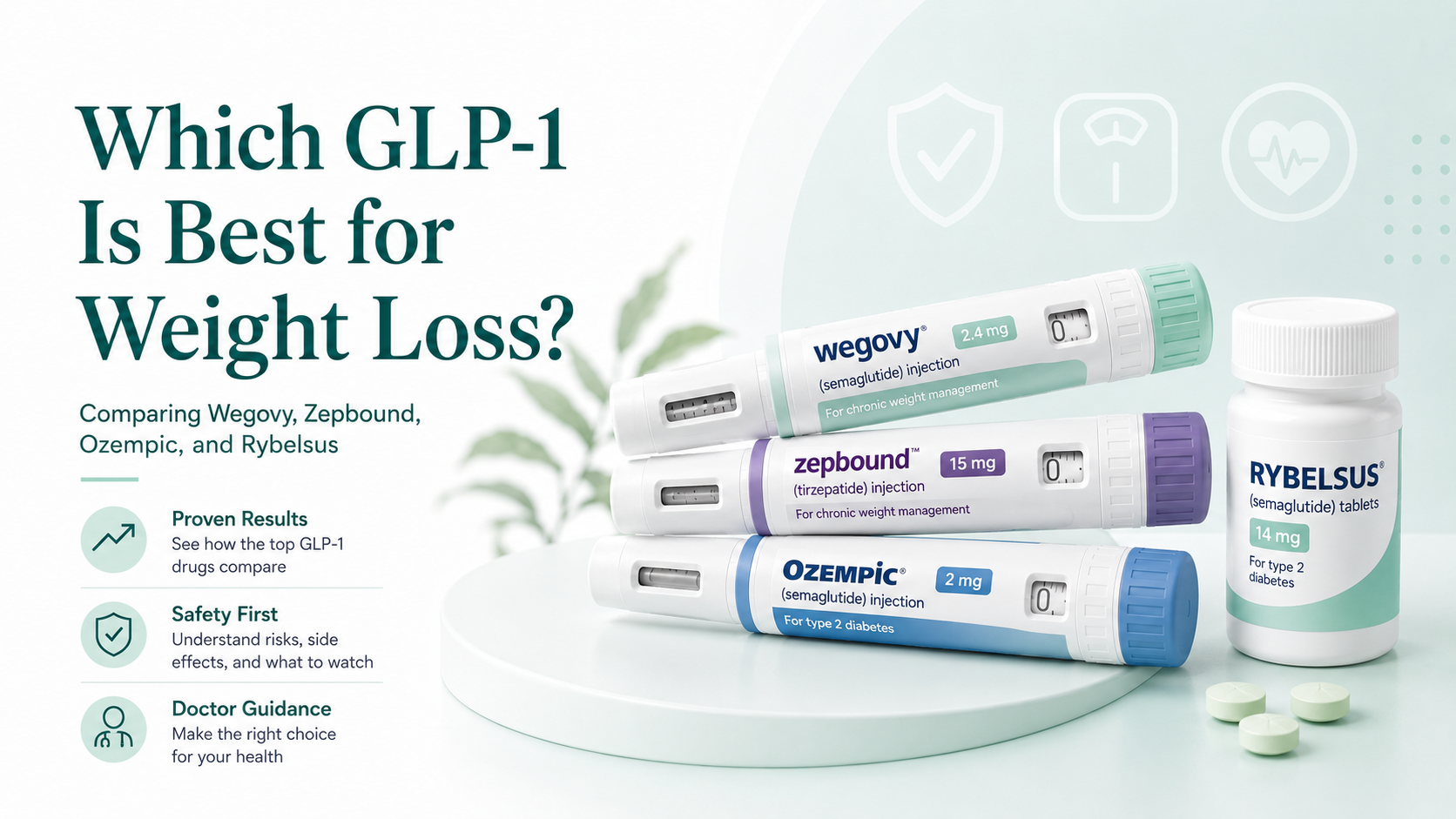
Which GLP-1 Is Best for Weight Loss? Comparing Wegovy, Zepbound, Ozempic, and Rybelsus
Struggling to choose which GLP‑1 is best for weight loss? We compare Wegovy, Zepbound, Ozempic, and Rybelsus on efficacy, cost, and safety. See which wins.
Type “which GLP‑1 is best for weight loss” into a search engine and you get chaos. Headlines pit Wegovy against Zepbound, social media calls every injectable “Ozempic,” and the line between diabetes medicine and weight‑loss tool evaporates. That confusion pushes people toward the wrong drug — or a dangerous source. To cut through it, here’s a clear‑eyed look at the four brands, the trial data, and why the biggest number in a press release only gets you so far.
This article is for general education only and does not replace medical advice from a licensed healthcare professional.
Quick Answer: Which GLP‑1 Delivers the Most Weight Loss?
In the only direct comparison of these four brands, Zepbound (tirzepatide) produced an average 20.2% weight loss versus about 13.7% for Wegovy (semaglutide). That figure comes from SURMOUNT‑5, which Eli Lilly announced by press release in December 2024; as of July 2026, we have not found a peer‑reviewed publication of the trial. Both drugs are FDA‑approved for chronic weight management.
For a 220‑pound person, the difference is roughly 13–14 extra pounds lost on tirzepatide, but individual results vary widely. Cost, tolerability, insurance coverage, and whether you can manage a weekly injection all outweigh a single average. Ozempic and Rybelsus, meanwhile, are diabetes drugs not approved for weight loss alone.
Two Molecules, Four Brand Names
All four brands come down to two molecules.
Semaglutide mimics the gut hormone GLP‑1 to signal fullness, slow stomach emptying, and prompt insulin release. Novo Nordisk sells it as:
- 1Ozempic (weekly injection) — approved for type 2 diabetes only
- 2Wegovy (weekly injection) — same molecule, dosed to 2.4 mg for weight management
- 3Rybelsus (daily pill) — approved for type 2 diabetes only
Tirzepatide (Eli Lilly’s dual‑action molecule) activates both GLP‑1 and GIP (glucose‑dependent insulinotropic polypeptide) receptors, which may amplify appetite suppression and alter how the body handles fat. It’s sold as:
- 1Zepbound (weekly injection) — approved for weight management
Tirzepatide is also available as Mounjaro for type 2 diabetes, but that brand isn’t part of this head‑to‑head comparison.
What matters are the molecules (semaglutide and tirzepatide). The brand simply determines the FDA label and the maximum dose studied for a specific use.
Trial Data: What the Numbers Actually Say
The FDA approved Wegovy for chronic weight management in June 2021, Zepbound in November 2023. Both trials compared the drug against placebo, with all participants receiving lifestyle counseling.
Wegovy (semaglutide 2.4 mg) in the STEP 1 trial: mean weight loss of about 14.9% over 68 weeks, compared with 2.4% on placebo.
Zepbound (tirzepatide) in SURMOUNT‑1: weight loss ranged from roughly 15% (5 mg dose) to about 21–22.5% (15 mg dose) at 72 weeks, depending on the analysis. Even the lowest dose matched Wegovy’s average; the highest stretched the gap.
The most direct comparison is SURMOUNT‑5 (sponsored by Eli Lilly). Topline figures from December 2024 put tirzepatide at ~20.2% weight loss versus semaglutide at ~13.7%. The dual action likely explains the edge, but without full peer review these numbers are the best we have — not a final verdict.
Ozempic (maximum 2.0 mg) hasn’t been studied for weight loss in people without diabetes. Off‑label prescribing happens, but trial data for that use don’t exist. Rybelsus (oral semaglutide) is diabetes‑only, and as of July 2026, we could not confirm an FDA‑approved obesity‑specific oral dose. A 50 mg oral semaglutide pill did show about 15% weight loss in studies, yet standard Rybelsus doses (7 mg and 14 mg) remain tied to diabetes care.
What the Internet Gets Wrong
Averages hide wild variation. In trials, some people lost far more than the mean; a small percentage lost little or nothing. Genetics, metabolism, adherence, and side effects all shape the outcome.
A celebrity’s thinner face doesn’t reveal which drug they took. Rapid weight loss strips facial fat regardless of the method — “Ozempic face” is catchy shorthand, not a medical diagnosis. It isn’t a sign the drug is damaging your skin.
Compounded products are not FDA‑approved. Semaglutide or tirzepatide from a compounding pharmacy isn’t the same as an FDA‑cleared pen — those preparations haven’t been reviewed for safety, purity, or consistency.
Lose 15% on Wegovy and feel fine? Chasing an extra 5% on a drug that makes you too sick to continue isn’t an upgrade. Every major trial paired the medication with a reduced‑calorie diet and increased physical activity. The medicine helped people stick to those changes — it didn’t replace them.
What to Discuss With a Doctor
If you’re considering these medications, bring these questions:
- 1Is this brand FDA‑approved for weight loss, or is it a diabetes drug used off‑label? The safety data and dosing schedules differ.
- 2What side effects should make me call you? Both drugs carry risks of pancreatitis, gallbladder problems, and, rarely, severe stomach issues. Seek immediate medical attention for intense abdominal pain that doesn’t ease, vomiting that prevents keeping liquids down, or signs of dehydration.
- 3If I’m sold a “compounded GLP‑1,” what am I actually getting? No FDA‑approved generic or compounded version exists. Your prescriber should explain the risks.
- 4How do we set the starting dose and the pace of increases? Gradual dose escalation generally means less nausea. The exact pace is a medical decision — ramping up too fast can be hard to tolerate.
The Trial Winner Isn’t Your Prescription
Zepbound shows the highest average weight loss in the data we have. But the drug you can tolerate, afford, and actually fill from a legitimate source — that’s the one that works. And it must come with an FDA‑approved label for your goal.
Common Questions About Weight‑Loss GLP‑1s
Is Zepbound just a stronger version of Wegovy? No. Wegovy contains semaglutide, a single GLP‑1 agonist. Zepbound contains tirzepatide, a dual GIP/GLP‑1 agonist. One isn’t simply a higher dose of the other.
Can I take Ozempic for weight loss if my doctor prescribes it? Doctors can prescribe Ozempic off‑label for weight loss, but the FDA has not approved it for that use. The approved weight‑loss version of the same semaglutide molecule is Wegovy, tested at higher doses specifically for obesity.
Why isn’t Rybelsus considered a weight‑loss pill? Standard Rybelsus doses (7 mg and 14 mg) are approved only for type 2 diabetes. A 50 mg oral semaglutide pill has shown strong weight loss in studies, but as of July 2026 we could not confirm an FDA‑approved obesity‑specific oral dose.
Is tirzepatide safer than semaglutide? Both have similar safety profiles, with gastrointestinal side effects being the most common. Serious risks — pancreatitis, gallbladder disease, and a boxed warning for thyroid C‑cell tumors — apply to both. No long‑term safety advantage has been established.
Do these drugs cause thyroid cancer? Rodent studies found an increased risk of thyroid C‑cell tumors; it is unknown if the risk applies to humans. Both drugs carry a boxed warning. They should not be used by anyone with a personal or family history of medullary thyroid carcinoma or multiple endocrine neoplasia syndrome type 2. Report any neck lump, hoarseness, or trouble swallowing immediately.
What if I can’t afford Wegovy or Zepbound? Cost and insurance issues are beyond the scope of this comparison. Speak with your doctor and insurer about formulary options. Beware of cheap online “alternatives” claiming to be the same thing — compounded and unregulated products carry unknown risks.
Which one has the fewest side effects? Both drugs commonly cause nausea, diarrhea, and vomiting, especially at higher doses. A gradual dose increase helps. No head‑to‑head safety trial has shown one is gentler; tolerance varies from person to person.
Diana Gangan
Comments (0)
Be the first to comment on this article.
