
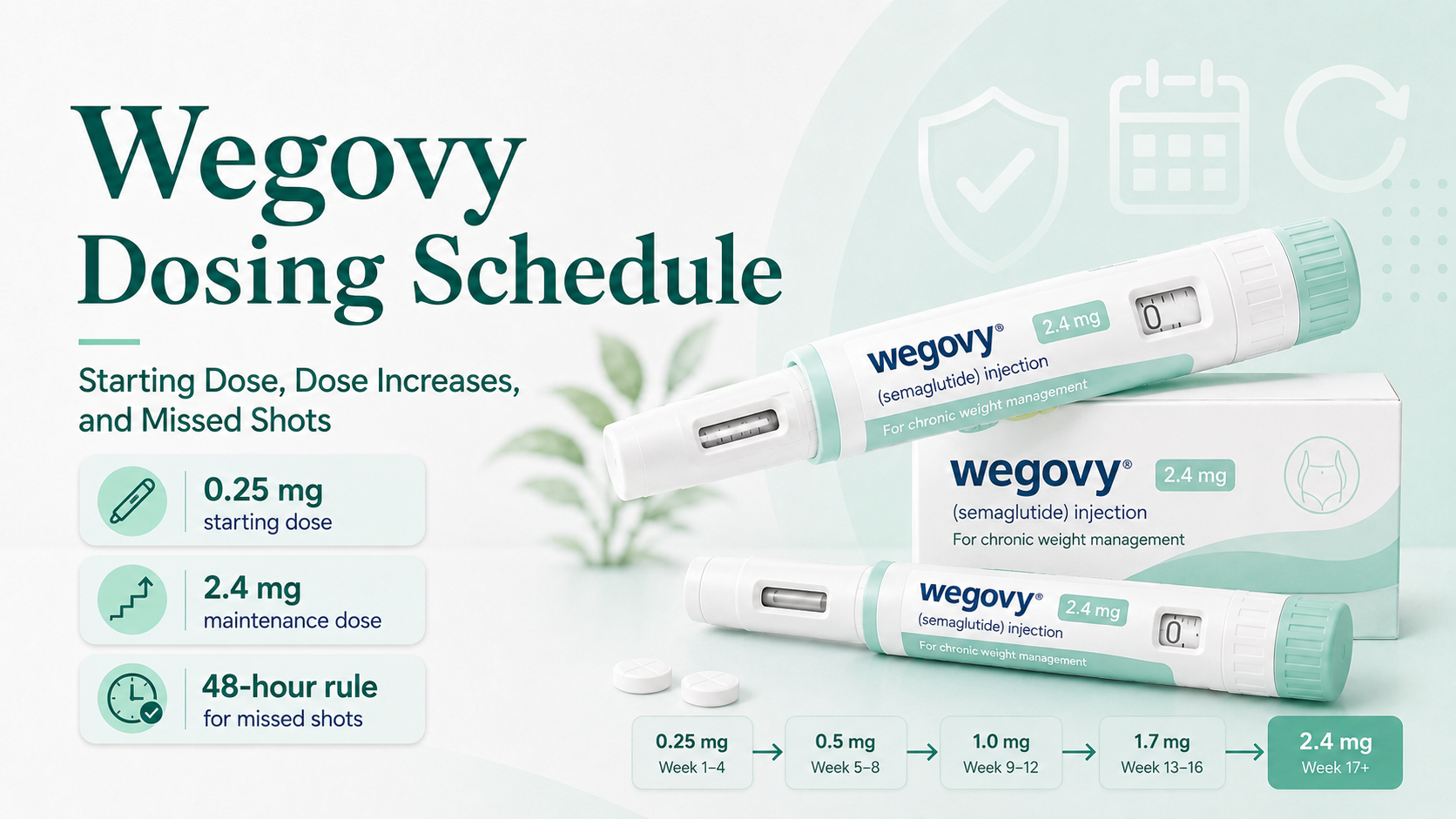
Wegovy Dosing Schedule: Starting Dose, Dose Increases, and Missed Shots
If you’re staring at a Wegovy pen, wondering whether to tweak your injection day or stressing over a missed dose, the internet has no shortage of advice—most of it likely to leave you queasy. Before you act on a forum tip, here’s the actual FDA-reviewed schedule, why the slow ramp exists, and which popular shortcuts you should skip.
The Wegovy dosing schedule is a carefully studied escalation — not the kind you improvise. If you’re holding a pen and wondering whether you can nudge your injection day, or panicking because you missed last week’s shot, the internet has opinions. Most of those opinions deliver nothing but nausea. Here’s the FDA-reviewed path, why it works, and which online shortcuts you’re safer ignoring.
This article is for general education only and does not replace medical advice from a licensed healthcare professional. Dosing decisions must always be made with your prescriber.
Quick Answer
Wegovy injection starts at 0.25 mg once weekly, then increases every four weeks to 0.5 mg, 1.0 mg, 1.7 mg, and finally 2.4 mg maintenance. Missed a dose? If your next scheduled dose is more than 48 hours away, you may take the missed dose when you remember. If less than 48 hours remain, skip the missed dose and resume your usual weekly schedule. Confirm the right move for your situation with your prescriber. The tablet form uses an entirely different set of dose strengths and its own escalation plan; the higher‑dose HD injection is not a starting option.
Why Wegovy Builds Up Slowly
Wegovy’s active ingredient, semaglutide, mimics the hormone GLP‑1. It slows stomach emptying, signals fullness, and helps regulate blood sugar — exactly what drives both weight loss and the digestive side effects. Because semaglutide’s half‑life (the time it takes for half the drug to clear your system) is about seven days, each weekly shot stacks on the last. Jumping to a high dose too soon overwhelms the gut before it can adjust.
The four‑week titration was built into the STEP 1 clinical trial of nearly 2,000 adults. Participants who followed the slow ramp lost roughly 15% of their body weight at 68 weeks on the final dose. The 0.25 mg starting dose exists purely to build tolerance, not to produce weight loss — most people won’t notice a change in the first month, and that’s expected.
| Weeks | Once‑Weekly Wegovy Injection Dose | |-------|-----------------------------------| | 1–4 | 0.25 mg (starting, not therapeutic) | | 5–8 | 0.5 mg | | 9–12 | 1.0 mg | | 13–16 | 1.7 mg | | 17+ | 2.4 mg (maintenance) — or 1.7 mg if the 2.4 mg dose is not tolerated |
If a dose isn’t well tolerated during escalation, the prescribing information allows delaying the increase for another four weeks. In adolescents aged 12 and up, the maintenance dose is 2.4 mg once weekly.
Wegovy Injection, Tablets, and the Higher‑Dose HD Shot: Know Which One You Have
As of July 2026, “Wegovy” refers to three separate products, each with its own dosing path. The numbers are not interchangeable, and mixing them up can be dangerous.
- 1Standard Wegovy injection: The 0.25 mg‑to‑2.4 mg escalation shown above.
- 2Wegovy HD injection (7.2 mg): Approved March 2026 for adults who have tolerated the 2.4 mg maintenance dose for at least four weeks and need additional loss. In the STEP UP trial (1,407 participants), the 7.2 mg dose led to 20.7% mean weight loss after 72 weeks, versus 15.6% for 2.4 mg and 3.9% for placebo. GI side effects were 70.8% vs. 61.2%. This is not a starting dose; it’s triple the previous maximum.
- 3Wegovy oral tablets: Approved December 2025. The daily dose rises from 1.5 mg (first month) to 4 mg, 9 mg, and finally 25 mg. Take on an empty stomach with a sip of water (no more than 4 oz) at least 30 minutes before eating, drinking, or taking other oral meds. Missed a day? Skip it, never double.
Nothing about these numbers transfers between the injection and the pill. A 1 mg injection and a 1.5 mg tablet are not comparable.
Missed Doses: The 2‑Day Rule — Not Mounjaro’s 4‑Day Rule
For the pill, the rule is straightforward: skip the missed day and take the next scheduled dose (never double up). For the injection, one of the most common points of confusion online is the Mounjaro (tirzepatide) 4‑day missed‑dose window. Wegovy uses a 2‑day (48‑hour) rule. The prescribing information is specific.
If your next scheduled injection is more than 2 days away, take the missed dose as soon as you remember, then resume your regular weekly schedule.
If your next scheduled dose is less than 2 days away, skip the missed dose entirely, and take the next dose on your usual day.
Do not take two doses close together. Doubling up sharply raises the risk of severe nausea, vomiting, and dehydration — exactly what the gentle titration was designed to prevent.
If it’s been two or more weeks since your last dose, you can take the next dose on your regular day, or talk to your prescriber about restarting at a lower dose.
Emergency note: Severe abdominal pain that radiates to the back, especially with persistent vomiting, can signal pancreatitis or gallbladder disease. Do not wait to see if it passes — seek emergency medical attention.
What the Internet Gets Wrong About Wegovy Dosing
Social media and forums are full of creative dosing strategies that sound clever but have no clinical backing.
- 1“The Mounjaro 4‑day rule works for Wegovy too.” It doesn’t. The two drugs have different half‑lives and different prescribing instructions. Applying tirzepatide’s missed‑dose window to semaglutide risks taking doses too close together.
- 2Split‑dosing or micro‑dosing. Some users split their weekly dose into smaller, more frequent injections. No large trial has evaluated this, and the safety signals — including unpredictable blood sugar drops if you’re on other medications — are unknown.
- 3“Tolerance resets” and deliberate breaks. Stopping and restarting at high doses without medical oversight can trigger the same intense GI side effects the four‑week ramp was designed to avoid.
The common thread: assuming a single positive experience equals safety. It doesn’t. Safety monitoring in clinical trials doesn’t look for what one person can get away with; it looks for rare but serious events across thousands of people. The standard titration was tested in the STEP program (about 4,500 adults across four major trials), the 7.2 mg dose in STEP UP (1,407), and the oral tablet path in OASIS 4 (307). No shortcut schedule — skipping steps, micro‑dosing, or resetting — has run that gauntlet.
What to Track or Discuss With a Doctor
The titration’s purpose is to learn what your body tolerates. Noting when nausea hits and whether it resolves tells your prescriber far more than a vague “I’m doing okay.” If a dose consistently causes vomiting that doesn’t ease within 24 hours, mention it before the next scheduled increase.
Questions worth raising at a follow‑up:
- 1“Should we stay at this dose another month before escalating?”
- 2“I missed two doses — how should we restart safely?”
- 3“Now that I’ve tolerated the 2.4 mg maintenance dose, is the HD injection appropriate for me, given my side‑effect history and weight loss so far?”
- 4“Could any of my other medications affect how I tolerate Wegovy?”
Never adjust your schedule on your own. If a dosing trick you read about online sounds appealing, bring it to the clinician who knows your labs and medical history — not a stranger on a forum.
Your Wegovy Dosing Plan
Wegovy’s dosing schedule is built on a slow ramp, a clear missed‑dose rule, and a strict separation between the injection, tablet, and HD forms. The numbers come from large trials; the shortcuts from comment sections. If you landed here searching “wegovy dosing,” you likely wanted the exact steps — they’re above — or what to do when a shot is missed. That answer is now in your hands. The rest — the micro‑dosing hacks, the tolerance resets, the rule borrowed from a different drug — can be safely left where they belong.
FAQ
Frequently Asked Questions
Yes. Rotating among the abdomen, thigh, and upper arm does not alter semaglutide absorption or effectiveness, according to the prescribing information.
Do not attempt to switch on your own. The pill uses its own dose‑escalation path (1.5 mg → 4 mg → 9 mg → 25 mg daily), and injection doses (0.25–2.4 mg weekly) do not translate. Only your prescriber can determine if a switch is right and how to do it safely.
After stopping, semaglutide takes about four to five weeks (roughly five half‑lives) to clear the body. Appetite and gastric effects can linger beyond that.
Yes. Unopened pens should be stored in the refrigerator (36°F to 46°F). Per the manufacturer, pens can be kept at room temperature up to 86°F for up to 28 days. Do not freeze them.
Wegovy HD (7.2 mg) is a higher‑dose injection approved for adults who have tolerated 2.4 mg for at least four weeks and need additional weight loss. It is not a starting dose and is associated with higher rates of digestive side effects than the standard maintenance regimen.
Diana Gangan
Comments (0)
Be the first to comment on this article.
