
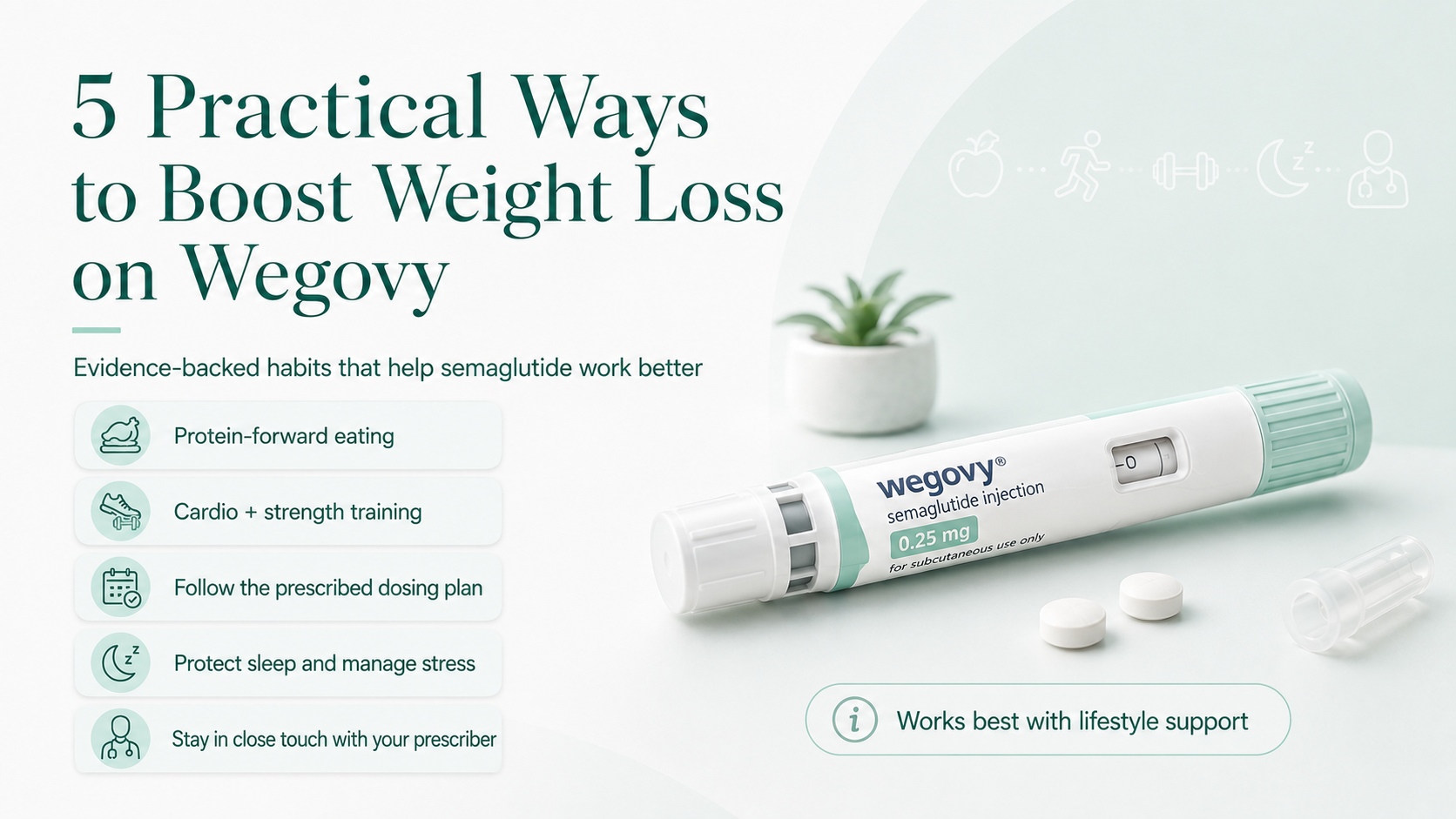
5 Practical Ways to Boost Weight Loss on Wegovy
Somewhere around month three, the scale that was cooperating so nicely on Wegovy suddenly stalls — and the internet's answers range from doubling your dose to buying someone's protein powder. What most of that noise misses is that Wegovy was never tested as a solo act: every major trial paired the drug with diet and exercise. The medication lowers your appetite, but what you do with that advantage is what separates trial-level results from real-world disappointment. These are the five moves with actual evidence behind them.
5 Practical Ways to Boost Weight Loss on Wegovy
Around month three, plenty of people on Wegovy hit the same wall. The early drop slows, the scale stalls, and the before-and-after photos online start to feel personal. That’s usually when someone types “5 ways to increase weight loss on Wegovy” — and gets back a swamp of protein-powder ads, forum threads about doubling doses, and celebrity gossip dressed up as endocrinology.
Here’s the starting point. Wegovy is the weight-loss brand of semaglutide, an FDA-approved prescription drug. (Ozempic contains the same molecule but is approved for type 2 diabetes — same ingredient, different product and purpose.) Semaglutide impersonates GLP-1 — glucagon-like peptide-1, the hormone your gut releases after a meal — so your brain registers less hunger and your stomach empties more slowly. You eat less without white-knuckling every meal.
But the trials behind the headline numbers all paired the drug with diet and exercise. It was never tested as a solo act — and that gap is exactly where the five moves below live.
> Medical disclaimer: This article is for general education only. It is not medical advice, and it does not replace guidance from a qualified healthcare professional who knows your history. Never start, stop, or change the dose of any medication based on something you read online — including here.
Quick Answer: The Five Moves With Real Evidence Behind Them
The five evidence-backed ways to increase weight loss on Wegovy are: eat a reduced-calorie diet built around protein, combine aerobic exercise with strength training, follow the dosing plan your prescriber sets, protect your sleep and manage stress, and keep your healthcare provider closely involved.
For fast reference:
- 1Protein-forward, reduced-calorie eating — a commonly cited target of 1.2–1.5 grams of protein per kilogram of body weight daily helps protect muscle while you lose.
- 2Cardio plus strength training — at least two resistance sessions a week.
- 3The prescribed dosing plan, followed consistently — trial results were strongest at maintenance dosing, reached gradually under medical supervision.
- 4Sleep and stress management — both directly shape hunger hormones.
- 5An engaged prescriber — monitoring and structured support improve adherence and outcomes.
Wegovy lowers appetite. These five can shape how much of that advantage turns into lasting loss.
The 5 Ways, With the Evidence Behind Each
1. Prioritize Protein, Not Just a Smaller Plate
The FDA label is explicit: Wegovy is approved in addition to a reduced-calorie diet and increased physical activity. Within that diet, protein does the heavy lifting. Rapid weight loss burns muscle along with fat, and muscle keeps your metabolism running. Lean sources — chicken, fish, tofu, legumes — help preserve it. Greasy and sugary foods add empty calories and tend to worsen nausea, the drug’s most common complaint.
2. Lift Weights Alongside the Cardio
Brisk walking or cycling burns calories; strength training tells your body to hold on to muscle. People who combine both generally lose more fat and keep their metabolic rate higher — a payoff that matters most when weight loss slows.
3. Let the Dosing Plan Do Its Job
Wegovy comes in multiple strengths, and prescribers start low and increase gradually, because a slow ramp keeps side effects tolerable. Work with your prescriber to follow that plan and, when medically appropriate, aim for the maintenance dose under supervision — the strongest trial results were seen at maintenance dosing. Real-world studies find people typically lose less than trial participants, largely because they stop early or never get to a maintenance dose. If you’re stalled, that’s a conversation for your prescriber — not a reason to improvise.
4. Protect Sleep and Manage Stress
Skimp on sleep or live chronically stressed, and your hunger hormones tilt toward craving. Behavioral weight-loss research consistently ties poor sleep to worse outcomes. Wegovy lowers appetite; it can’t out-signal a body running on five hours of rest.
5. Keep Your Prescriber Actively Involved
Regular follow-ups mean side effects get managed before they derail you and stalls get properly investigated. Structured programs and dietitian support improve adherence — and adherence, more than any hack, separates trial-level results from real-world disappointment.
The Pen, the New Pill, and Why the Source Matters
Wegovy now comes in two forms. The weekly injection pen has been around since June 2021, with a newer higher-dose “HD” pen (approved March 2026) available for adults who have tolerated the standard maintenance dose. The daily Wegovy pill (approved December 2025) is the first oral GLP-1 for weight management; it follows its own gradual ramp and comes with strict label rules about taking it on an empty stomach before food, drink, or other medications. The full Wegovy product line is covered separately.
Two cautions. First, the pill and the HD pen each rest on a single pivotal trial; the standard pen has a much deeper evidence base. Second, compounded semaglutide sold online is not the same product — the FDA has warned it isn’t reviewed for safety, quality, or accurate dosing.
What the Trials Show vs. What the Forums Claim
First, the human trial numbers. STEP 1 produced about 14.9% average loss at 68 weeks. STEP UP, the trial behind the HD pen, reached 18.7% across all participants and 20.7% among those who stayed on treatment — and the viral “27.7%” figure applies only to a subgroup of early responders, not the average patient. The pill’s OASIS 4 trial showed 13.6% overall, 16.6% among the treatment-adherent.
On Zepbound vs. Wegovy: the SURMOUNT-5 head-to-head trial found tirzepatide (Zepbound) beat semaglutide on average weight loss — 20.2% vs. 13.7% over 72 weeks. But Wegovy carries indications Zepbound lacks, including cardiovascular risk reduction (2024) and MASH, a serious fatty-liver disease (2025), while Zepbound is approved for obstructive sleep apnea. Wegovy vs. Zepbound isn’t a leaderboard question; it depends on your health profile.
And the forums? Individual reviews can tell you what a stall feels like, not why it happened. Same for “Ozempic face”: that’s facial fat loss from rapid weight loss of any cause — not a drug-specific side effect, and not a diagnosis.
Wegovy Side Effects: What to Track and When to Call
The most common Wegovy side effects — nausea, diarrhea, vomiting, constipation, fatigue — are usually worst when the dose increases and ease as your body adjusts. The label carries a boxed warning about thyroid C-cell tumors seen in rodent studies; whether that risk applies to humans is unknown, but the warning stays.
Call a doctor promptly for severe abdominal pain that radiates to your back (possible pancreatitis), pain in the right upper abdomen (gallbladder trouble), sudden vision changes, or severe constipation — the FDA added intestinal obstruction to the label in October 2025. For balance: the FDA’s adverse-event database holds thousands of Wegovy reports, but those are unverified submissions — a signal to study, not proof of harm.
What the Internet Gets Wrong About “Boosting” Wegovy
- 1“Take an extra shot to break a stall.” Doubling doses amplifies side effects, not fat loss — see what a Wegovy overdose actually involves.
- 2“Compounded semaglutide is the same thing, cheaper.” It isn’t FDA-reviewed. Full stop.
- 3“Everyone loses 27%.” That was a small subgroup of early responders on the highest dose studied.
- 4“A stall means the drug stopped working.” More often it’s calorie creep, lost muscle, or a dosing plan that was never completed — all worth a real appointment.
What Wegovy Costs — Because It Affects Results
Stretching doses to save money directly undermines way #3, so the numbers matter. List price runs about ,350 a month. With commercial insurance, the manufacturer’s savings card can drop that to $25 — sometimes $0. Self-pay through NovoCare Pharmacy or a GoodRx coupon runs roughly 99–$349 a month for most pen strengths ($399 for the HD pen) and 49–$299 for the pill, at 70,000+ pharmacies. The Medicare GLP-1 Bridge program covers Wegovy at a $50 flat copay through December 2027. Full breakdown in our Wegovy coupon and cost guide.
The Bottom Line
Wegovy changes your appetite. It never promised to do the rest. In every major trial, the people who lost the most paired the medication with protein, strength training, decent sleep, and a dosing plan they actually stayed on. That’s not fine print — it’s the mechanism behind the 15% headlines. These five aren’t boosters stacked on top of the drug; they’re the conditions the drug was designed to work within.
FAQ
Frequently Asked Questions
About 15% of body weight on average over 68 weeks in the pivotal STEP 1 trial, alongside diet and exercise. The higher-dose HD pen averaged roughly 19–21% at 72 weeks in its trial. Real-world results are typically lower.
Common explanations: the dosing plan isn’t complete, calories are creeping up, muscle loss is slowing metabolism, or you’ve hit the normal plateau after early rapid loss. Talk to your prescriber — don’t fix it by doubling doses.
In its approval trial, the pill produced 13.6% average weight loss (16.6% among those who stayed on treatment) — broadly in line with the standard injection, though the two weren’t compared head-to-head. It comes with a strict empty-stomach morning routine set out in the label.
In the only head-to-head trial, Zepbound (tirzepatide) led, 20.2% vs. 13.7% over 72 weeks. But the drugs have different FDA approvals, and the right choice depends on your health profile — a prescriber’s call, not a leaderboard.
Yes. Commercially insured patients may pay as little as $25 a month with the manufacturer’s savings card; self-pay prices through NovoCare Pharmacy and GoodRx run roughly 49–$399 depending on the form.
Nausea, diarrhea, vomiting, and constipation — typically worst when the dose increases and easing as your body adjusts.
Diana Gangan
Comments (0)
Be the first to comment on this article.
