
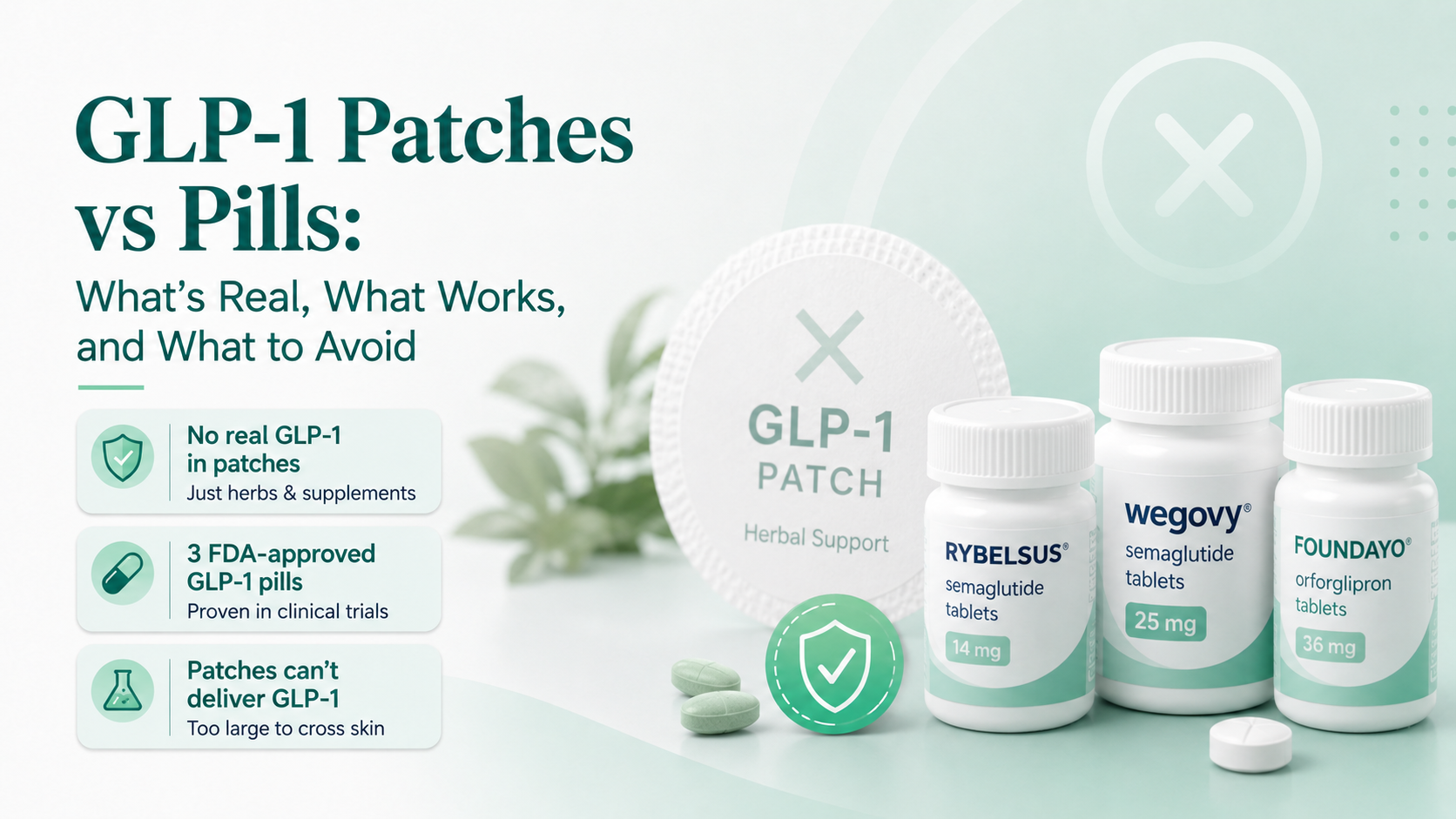
GLP 1 Patches vs Pills: What’s Real, What Works, and What to Avoid
Scrolling past ads for "GLP‑1 patches"? Those stickers contain no semaglutide or tirzepatide — just herbs that can’t penetrate your skin, let alone curb your appetite. Actual GLP‑1 medications come in three FDA‑approved oral pills, backed by rigorous trials and weight loss of up to 16.6%.
If you’ve seen advertisements for GLP‑1 patches, know this: no patch sold online contains a single milligram of an actual GLP‑1 medication. Three oral pills are FDA‑approved; zero transdermal patches can deliver one. The gap between social‑media marketing and medicine isn’t small — it’s a physical impossibility dressed up in scientific‑sounding labels.
Disclaimer: This article is for general education only and does not replace medical advice from a licensed healthcare professional.
Quick Answer
GLP‑1 patches are not real GLP‑1 drugs. They’re dietary‑supplement stickers — mostly berberine and herbs. No semaglutide, tirzepatide, or liraglutide. The molecules in genuine GLP‑1 medications are far too large to cross intact skin with today’s commercial patch technology. Three FDA‑approved oral GLP‑1 pills exist — Rybelsus, Wegovy pill, and Foundayo — each backed by large human trials. The patches sold online have zero clinical evidence of weight‑loss efficacy and no FDA approval.
Why a Patch Can’t Work — the Physical Wall, Not a Regulatory Snag
The patches promoted as “GLP‑1 patches” are supplements, not drugs. Kind Patches, one of the most visible sellers, once listed its “GLP‑1 Support” patches with berberine (7–8.75 mg), pomegranate extract, cinnamon, and B vitamins. After public criticism, the company quietly renamed the product “Berberine Patches” — though the packaging still nods to the GLP‑1 trend. There never was any semaglutide or tirzepatide inside. The FDA directly told TODAY.com that no GLP‑1 patch has been approved, and a January 2026 review in the Annals of Pharmacotherapy concluded there is zero evidence that berberine or any listed ingredient absorbs through intact skin — and that the products violate labeling rules.
Real GLP‑1 medications are either large peptides like semaglutide (roughly 4,113 daltons) or non‑peptide small molecules like orforglipron. Your skin’s outermost layer is a formidable barrier; molecules generally need to stay under 500 daltons to slip through passively. Semaglutide is about eight times too heavy — like trying to push a marble through a coffee filter. Even if a patch somehow contained the drug, commercial transdermal technology can’t get it into the bloodstream today. Legitimate research on microneedle patches (tiny needles that bypass the outer skin) is still in animal studies — mice, rats, guinea pigs — and a working patch for people is at least three to five years away, assuming clinical development goes perfectly.
How a Pill Succeeds Where a Patch Fails
GLP‑1 receptor agonists mimic a natural hormone that slows stomach emptying, curbs appetite, and helps the pancreas release insulin after meals. Injectable versions like Ozempic and Wegovy deliver the peptide directly under the skin, skipping the gut. A pill faces stomach acid and enzymes that would shred a naked peptide. To make oral semaglutide viable, Rybelsus and the newer Wegovy pill include an absorption enhancer called SNAC (salcaprozate sodium). SNAC briefly buffers stomach pH and makes the gut lining just permeable enough for the large peptide to slip through. Without SNAC, oral semaglutide’s bioavailability would be under 1% — a placebo in pill form.
That’s why these pills come with strict rules. Oral semaglutide must be taken on an empty stomach with no more than 120 mL of plain water; the patient then needs to wait at least 30 minutes before eating, drinking, or taking other medications. Break those rules and you break the delivery system.
The third approved pill, orforglipron (Foundayo), solves the size problem differently. It’s not a peptide — it’s a small‑molecule GLP‑1 receptor agonist, small enough to cross cell membranes on its own. No SNAC, no fasting, any time of day. Patches have no comparable trick. The herbs inside can’t stimulate GLP‑1 receptors through skin, and no published human study has ever shown otherwise.
The Three FDA‑Approved GLP‑1 Pills (All Prescription)
| Medication | Active Ingredient | Approved For | Key Detail | |-------------|-------------------|--------------|-------------| | Rybelsus | Semaglutide (7 or 14 mg) | Type 2 diabetes; cardiovascular risk reduction in T2D (added Oct 2025) | First oral GLP‑1 (2019). Uses SNAC; strict fasting required. ~2–4 kg (roughly 4–9 lb) weight reduction in PIONEER trials. | | Wegovy pill | Semaglutide (25 mg) | Chronic weight management in adults with obesity/overweight; cardiovascular risk reduction | Approved Dec 2025. Uses SNAC; strict fasting required. Mean 16.6% weight loss at 64 weeks in OASIS 4 trial. | | Foundayo | Orforglipron (non‑peptide) | Chronic weight management in adults with obesity/overweight | Approved Apr 2026. Small molecule — no SNAC, no fasting. Mean 12.4% weight loss at 72 weeks (ATTAIN‑1, 36 mg dose). |
All three are backed by large Phase 3 randomized controlled trials — evidence completely absent for “GLP‑1 patches.”
Social Media Testimonials vs. Clinical Data
A sticker in a before‑and‑after photo proves one thing: they wore a sticker. Without a control group, blinded design, or ingredient verification, a photo tells you nothing about what caused the weight loss. A person who diets, exercises, or takes other medications while wearing a berberine patch may lose weight; crediting the sticker is a classic post hoc mistake.
Real oral GLP‑1s come with data. The Wegovy pill’s OASIS 4 trial showed 16.6% body‑weight reduction versus 2.7% for placebo. Foundayo’s ATTAIN‑1 trial showed 12.4% loss versus 0.9% placebo. Thousands of participants, systematically tracked side effects (nausea, diarrhea, constipation, vomiting), and dose‑response curves. Patch testimonials rarely mention side effects because herbal supplements in patch form don’t trigger the same gut‑brain signaling that real GLP‑1 agonists do — and because nobody is monitoring them.
Red Flags and Safety: What to Discuss with a Doctor
Delaying proven treatment while experimenting with an unregulated sticker can cost you time — especially if a medical weight‑management plan could prevent diabetes or a cardiovascular event.
- 1For GLP‑1 patches: Show the label. Ask whether oral berberine has any robust weight‑loss data (the evidence is modest and often confounded) and whether absorption through intact skin is even plausible. Mention all medications you take — berberine, even in oral form, can interact with drugs metabolized by the liver.
- 2For real pills: Discuss any history of pancreatitis, gallbladder disease, or thyroid C‑cell tumors (a boxed warning exists for medullary thyroid carcinoma risk in rodents; human relevance is unclear). Review the strict administration rules for oral semaglutide — many people find them burdensome and risk missing doses. Mild nausea or diarrhea may be manageable, but severe abdominal pain, unstoppable vomiting, or signs of an allergic reaction need immediate medical attention — not a scheduled visit.
- 3A special warning: Injecting or swallowing research‑grade GLP‑1s bought outside regulated channels is a legal and safety gamble. No patch or pill sold on a peptide research site has FDA review; sterility, potency, and purity are unknowns.
What the Internet Gets Wrong
- 1“GLP‑1 patch” is a marketing label, not a drug class. It borrows the credibility of real medications without containing the active ingredient.
- 2No patch can push semaglutide or tirzepatide through intact skin with current technology. The molecular‑size barrier is a physical wall. Microneedle research is preclinical and nowhere near store shelves.
- 3“Ozempatches” is a social‑media nickname, not a medical product. The term was coined on platforms, not in a lab. No such product is approved or validated.
- 4Celebrity before‑and‑after posts are not proof. Rapid facial changes, loose skin, or “Ozempic face” accompany fast weight loss from any cause — severe calorie restriction, surgery, or real GLP‑1s. They don’t verify that a patch caused the loss.
- 5Real oral GLP‑1s are not interchangeable. Rybelsus and the Wegovy pill share semaglutide and SNAC but serve different patient needs. Foundayo is an entirely different molecule. Treating them as equivalents is dangerously simplistic.
- 6The FDA is actively chasing misleading GLP‑1 marketing. Dozens of warning letters went out in 2025 and 2026 to compounders, manufacturers, and telehealth companies. The pressure tells you how widespread the misinformation has become.
Evidence‑Based Options (and the One to Throw Away)
A “GLP‑1 patch” you can buy right now is a supplement with no GLP‑1 drug, no working skin‑absorption mechanism for peptides, and zero clinical evidence of weight‑loss efficacy. The legitimate oral options — Rybelsus, Wegovy pill, Foundayo — are prescription medications with large human trials, each carrying its own chemistry, dosing rules, and safety profile.
If you’re looking for a GLP‑1 medication, the real choices today are injectable or one of those three pills. A patch isn’t a shortcut — it’s a wallet‑sized container of false hope dressed in scientific‑sounding marketing. The internet promises shortcuts; metabolism doesn’t bend to stickers.
Disclaimer: This article is for general education only and does not replace medical advice from a licensed healthcare professional.
FAQ
Frequently Asked Questions
No. Microneedle research is still locked in animal studies — no human trials have started. A commercial patch is at least three to five years away, and that’s assuming flawless clinical development and FDA approval.
Most widely sold patches contain berberine extract, cinnamon, pomegranate, and vitamins. Zero semaglutide, zero tirzepatide — nothing prescription‑strength. Oral berberine may have a modest effect on glucose metabolism in some studies, but there’s no proof it absorbs through intact skin in meaningful amounts, and it is not a GLP‑1 medication.
They can. The Wegovy pill (25 mg oral semaglutide) delivered 16.6% weight loss in its pivotal trial — comparable to the ~15% weight loss seen with injectable semaglutide in the STEP 1 trial. Foundayo averaged 12.4% but eliminates the fasting requirement. Both are legitimate alternatives backed by large trials.
No. Semaglutide’s size (roughly 4,113 daltons) is far too large for passive skin absorption — the 500‑dalton rule applies. Experimental microneedle or nanoparticle patches have shown limited success in animals, but none are commercial products.
You’d be buying a sticker and losing time. If you need medical weight management for a condition that’s hurting you, weeks spent on a fake patch are weeks a real medication could have been working. Talk to your doctor about prescription options instead of reaching for an unregulated supplement.
Diana Gangan
Comments (0)
Be the first to comment on this article.
