
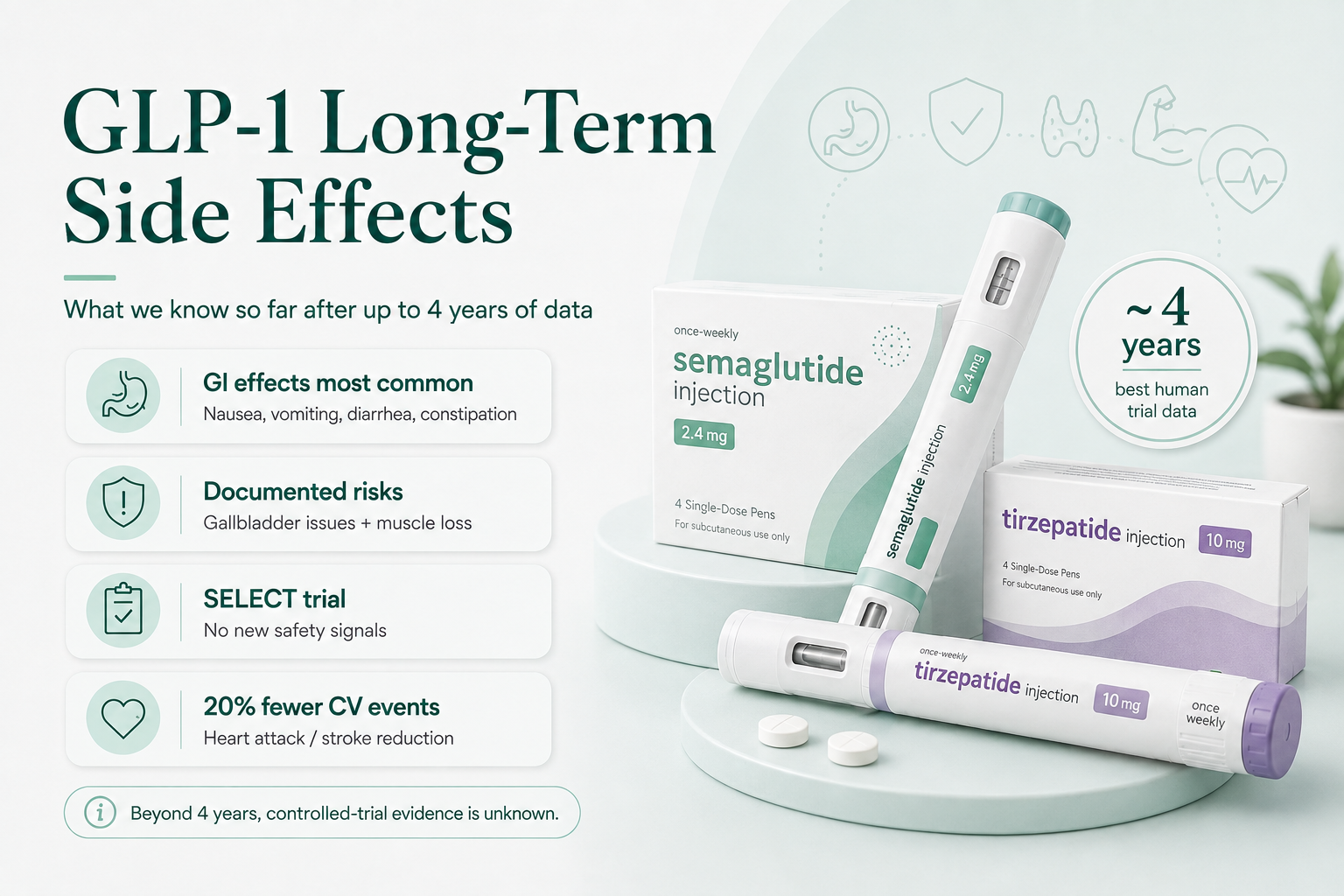
GLP-1 Long-Term Side Effects: What We Know So Far
Millions of people have now spent years on drugs like semaglutide and tirzepatide — yet the loudest voices online, in both directions, claim a certainty the evidence doesn't yet support. The most rigorous trial data spans only about four years, which means the honest answers live somewhere between the hype and the horror stories. Drawing on large trials, real-world databases, and two decades of experience with older drugs in the same class, this guide separates documented risks from rodent-study warnings and internet folklore.
The most rigorous trial data on GLP-1 long-term side effects spans roughly four years. Semaglutide was first approved in 2017, tirzepatide in 2022. Millions have now taken these drugs for years — yet the loudest online voices, in both directions, claim a certainty the evidence doesn’t yet support.
Large trials, real-world databases, and two decades of older drugs in the same class do let us separate documented effects from rodent-study warnings and internet folklore. Here is that map.
Quick Answer
The most common long-term GLP-1 side effects are gastrointestinal: nausea, vomiting, diarrhea, and constipation. Gallbladder problems and muscle loss alongside weight loss are documented risks. The thyroid tumor warning comes from rodent studies and remains unconfirmed in humans; the pancreatitis link is disputed, with large trials finding no increase. The SELECT trial — the longest major study, at about four years — found no new safety signals and 20% fewer heart attacks and strokes. Beyond four years, controlled-trial evidence simply does not exist.
What GLP-1 Actually Is — and Why It Causes These Effects
GLP-1 (glucagon-like peptide-1) is a hormone your gut releases after eating. It triggers insulin when blood sugar is high, slows how fast the stomach empties, and signals fullness to the brain. Your body destroys natural GLP-1 within minutes using an enzyme called DPP-4. The medications are engineered to resist that breakdown, so one dose works for days or weeks — which also means the stomach-slowing never fully switches off between doses (mechanism review, Cell Metabolism; GoodRx explainer).
“GLP-1 drugs” are a class, not one product. Semaglutide (Ozempic, Wegovy, Rybelsus), tirzepatide (Mounjaro, Zepbound — technically a dual GIP/GLP-1 agonist), liraglutide, and dulaglutide each carry different approvals and side-effect rates. GLP-1 pills have expanded too: Rybelsus, an oral Wegovy, and orforglipron (Foundayo, approved April 2026), the first small-molecule oral in the class. Our comparison of Wegovy, Zepbound, Ozempic, and Rybelsus breaks down the differences.
The Long-Term Side Effects With Solid Human Data
Gastrointestinal effects top every list. At the semaglutide 2.4 mg weight-loss dose, trials recorded nausea in 44% of patients, vomiting in 24%, and diarrhea in 31%; 7% stopped treatment over GI effects. Symptoms are dose-dependent and usually ease, but they remain the leading reason people quit (trial data summary).
Gastroparesis — stomach emptying slowed well beyond the intended effect — shows up in real-world reports, with some patients’ emptying delayed to levels “indicative of gastroparesis” (Diabetes & Metabolism Journal, 2025).
Gallbladder problems, including gallstones and inflammation, are a recognized risk — partly because rapid weight loss itself promotes gallstones. Kidney stones are documented too (GoodRx side-effect review).
Muscle and bone get less attention than they deserve. A meaningful share of weight lost is lean mass, muscle included. Some studies found bone density declines at the hip and spine; a 2025 meta-analysis found no increased fracture risk in people with type 2 diabetes — the weight-loss-versus-drug question is unsettled (PubMed). The National Academy of Medicine has flagged frailty risk in older adults.
Eye changes in diabetics: rapid blood-sugar improvement can temporarily worsen diabetic retinopathy (existing damage to the retina). A retinal check before starting is recommended for people with diabetes (JCI review).
The Scary Headlines Rest on Thinner Evidence
Thyroid tumors. Every approved drug in the class carries a boxed warning — the FDA’s strongest — about thyroid C-cell tumors. That warning rests on rodent studies and has never been confirmed in humans. Higher detection rates in some databases may simply reflect more thyroid ultrasounds among GLP-1 users. Still, anyone with a personal or family history of medullary thyroid carcinoma or MEN2 (an inherited cancer syndrome) is advised against these drugs (GoodRx; DMJ 2025).
Pancreatitis. Genuinely mixed. One 2025 observational analysis of over 200,000 patients found a 2–2.5x higher rate of drug-induced pancreatitis (summary). Yet a Journal of Clinical Investigation review says long-term trials have “dispelled” the concern, while a 2026 review calls pancreatic risk an open question. Honest summary: randomized trials — the stronger evidence — are reassuring; observational studies, which can spot associations but not prove cause, keep the question alive.
Mood changes. Real-world analyses have raised questions about anxiety and mood shifts. This is an emerging signal, not a confirmed trial finding (HealthVerity, 2025).
The Often-Overlooked Benefits, and the Four-Year Ceiling
The SELECT trial — 17,604 adults followed about 3.5 to 4 years — found semaglutide cut major cardiovascular events (heart attack, stroke, cardiovascular death) by 20% and adverse kidney outcomes by 22%, with no new safety concerns. Weight loss of about 9.4% was sustained — but only while patients stayed on the drug (SELECT, PubMed; EASO).
Beyond four years, there is no controlled-trial data for any GLP-1 drug. Exenatide, the oldest, reached market in 2005. Anyone claiming to know the 15-year picture is guessing.
Where You Get It Changes the Risk: Brand, Compounded, Pills, and Patches
Compounded semaglutide and tirzepatide — pharmacy-made copies sold widely during the shortage — are not FDA-reviewed for safety or quality. By April 30, 2025, the FDA had logged 520 adverse event reports for compounded semaglutide and 480 for compounded tirzepatide, including patients who accidentally injected 5 to 20 times the intended dose (UIC College of Pharmacy). In February 2026, the FDA moved to restrict the bulk ingredients.
GLP-1 patches deserve a blunt sentence: no GLP-1 patch is FDA-approved, and the patches sold online contain no GLP-1 at all. The peptide molecule is too large to cross skin; real microneedle patches are only in early trials, with the earliest realistic availability around 2028–2030 (Doctronic, 2026). What’s sold today is an herbal supplement wearing a pharmaceutical costume — see our breakdown of GLP-1 patches vs. pills: what’s real and what to avoid.
And “Ro GLP-1” searches? Ro is not a drug. It’s a telehealth membership (the Ro Body Program) where licensed providers prescribe FDA-approved medications (Forbes Health review).
What to Track and Bring Up With a Doctor
Seek prompt medical care for: severe or persistent abdominal pain (possible pancreatitis or gallbladder trouble), vomiting that won’t stop or inability to keep fluids down, a neck lump or persistent hoarseness, vision changes if you have diabetes, new or worsening depression, or noticeable loss of strength.
Useful questions for an appointment: Do I need a retinal exam before starting? Should my bone density be monitored, given my age? How do I protect muscle — what protein intake and resistance training make sense for me? Does my family thyroid history change anything?
What the Internet Gets Wrong
- 1“Ozempic face” is a media nickname for facial fat loss that happens with any rapid weight loss. It is not a diagnosis and not drug-specific.
- 2“GLP-1 patches” online contain zero GLP-1. See above.
- 3Compounded is not “generic.” Generic drugs are FDA-evaluated. Compounded versions are not.
- 4“GLP-1” is not one drug — it’s a class with meaningfully different risk and benefit profiles.
- 5Forums oversample extremes. People with uneventful years on these drugs rarely post about it.
Bottom Line
Four years of large-trial data show a manageable safety profile dominated by GI effects, plus real cardiovascular and kidney benefits. Muscle loss and gallbladder risk are documented and worth monitoring. The frightening signals — thyroid cancer, pancreatitis, mood effects — remain unconfirmed or disputed in humans. And nothing is known past the four-year mark. That argues for medical supervision and periodic re-evaluation, not for either panic or complacency.
FAQ
Frequently Asked Questions
The honest ceiling of evidence is about four years from controlled trials, with no new safety signals found within that window. Longer trials are underway. Whether to continue is a decision to revisit with your prescriber as new data arrives.
Not confirmed. The boxed warning is based on rodent studies. People with a personal or family history of medullary thyroid carcinoma or MEN2 are advised to avoid the class as a precaution.
Appetite and gastric emptying return toward baseline, and weight regain is the expected pattern — trial data show benefits held only while patients stayed on treatment.
No FDA-approved GLP-1 patch exists. Patches sold online are herbal supplements that contain no GLP-1 receptor agonist whatsoever.
Some lean mass is lost with any major weight loss; how much is drug-specific versus weight-loss-related is unsettled, and long-term functional outcomes are understudied. Protein intake and resistance training are worth discussing with your clinician — especially if you’re older.
Diana Gangan
Comments (0)
Be the first to comment on this article.
