
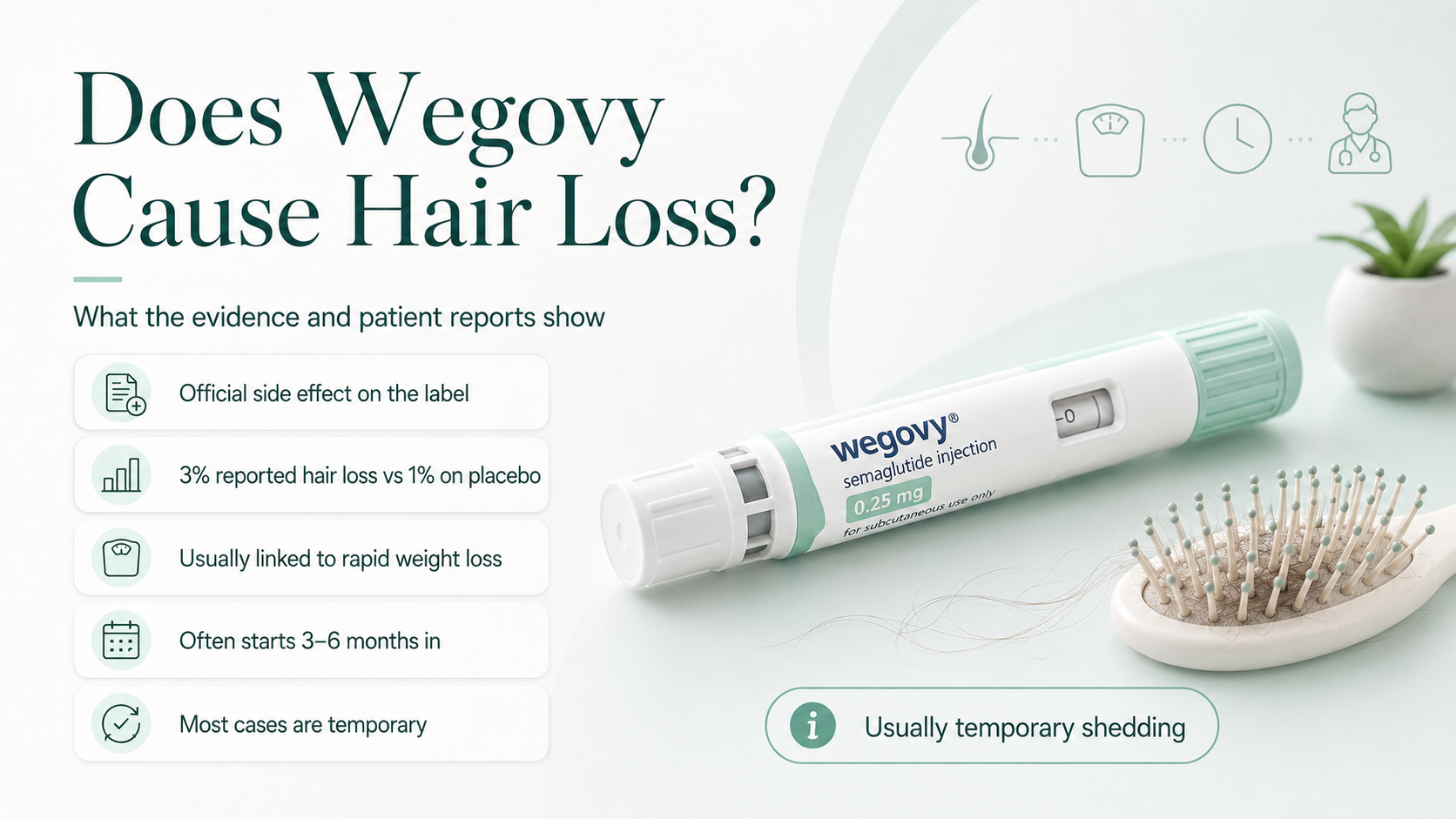
Does Wegovy Cause Hair Loss? What the Evidence and Patient Reports Show
More hair in the brush a few months into semaglutide is not your imagination — hair loss is on Wegovy's official label, reported by 3% of trial users versus 1% on placebo. But the evidence increasingly points to rapid weight loss itself, not the drug, as the trigger behind most cases, which changes what you can expect and what actually helps. Here's what the trials, real-world data, and patient reports show — plus the timing, labs, and questions worth raising with your prescriber.
Three months into Wegovy, the scale is finally moving — and so is your hair. More on the brush, more in the drain. You search “does Wegovy cause hair loss” and land in a forum war: the drug is destroying hair, or it’s just the weight loss, depending on who’s shouting.
The truth is split. Hair loss is on the label — 3% of Wegovy users reported it in trials, compared to 1% on placebo. But the identical shedding pattern shows up after crash diets and bariatric surgery, in people who never touched a GLP-1 drug. Whether the drug or the weight drop is driving it matters, because that determines if the hair comes back — and what actually helps.
This article is for general education only and does not replace medical advice from a licensed healthcare professional.
Quick Answer
Yes, hair loss (alopecia) is an official side effect of Wegovy. In pooled trials, 3% of users reported hair loss vs 1% on placebo; in adolescents, 4% vs 0%. The likely cause is telogen effluvium — temporary shedding triggered by rapid weight loss, not direct damage to follicles from semaglutide. Shedding typically begins three to six months into weight loss and regrows once weight stabilizes. Ninety-seven percent of trial users had no hair loss at all.
Why Fast Weight Loss — Not the Drug — Explains Most Cases
Wegovy (semaglutide 2.4 mg) mimics the gut hormone GLP-1, curbing appetite and slowing stomach emptying. In the STEP 1 trial, participants lost an average of 14.9% of their body weight over 68 weeks.
Hair is expensive tissue. When calories drop sharply, the body triages — vital organs first, hair last. A wave of follicles shifts from growth to resting phase, and a few months later they fall out together. Dermatologists call this telogen effluvium: diffuse shedding, not bald patches.
The evidence points at the weight loss, not the molecule:
- 1People who lose weight fast without any drug shed too. A pooled analysis of bariatric surgery patients put the telogen effluvium rate around 57%.
- 2A study of weight-loss-related shedding placed the threshold at roughly 15% body weight lost, or a pace near 3.5 kg (about 8 lb) per month. STEP 1’s average sits squarely in that zone.
- 3Tirzepatide (Zepbound, Mounjaro), which produces even larger weight loss, shows a higher hair-loss signal — about 5% in trials vs 0.9% on placebo.
- 4Wegovy’s FDA label describes its hair loss reports as “associated with weight reduction.”
The Dose and the Brand Change the Answer
Same molecule, different label. Ozempic is semaglutide too, but at lower doses (up to 2 mg) for type 2 diabetes. In its trials, weight loss was modest and no hair-loss signal emerged — so alopecia sits only in Ozempic’s “postmarketing” section, meaning cases were reported after approval, at unknown frequency. It is not among Ozempic’s common side effects.
Wegovy, at the full weight-loss dose, is where the 3% figure lives. The signal also isn’t unique to semaglutide: between December 2024 and May 2025, the FDA added alopecia to the labels of several other GLP-1 medications. Wegovy’s and Zepbound’s labels already listed it.
Crucially, all these numbers come from pharmaceutical-grade, FDA-approved products. Compounded semaglutide and gray-market “research” peptides are not interchangeable with the approved formulations covered in our Wegovy products overview, and no trial-grade safety data exists for them.
What Human Studies Show — and Where Anecdotes Go Wrong
Unlike many peptide topics, the evidence here is human and reasonably solid. The pooled trial figures — 3% vs 1%, and 4% vs 0% in teens — come from randomized controlled data. High-dose oral semaglutide (50 mg) showed 7% vs 3%, hinting the risk climbs with dose. A 2026 meta-analysis put the overall risk at 3.4 times placebo, but with a wide confidence interval. The signal is real; its exact size, uncertain. A real-world cohort of over 547,000 matched adults found GLP-1 users about 40% more likely to be diagnosed with non-scarring hair loss, and 76% more likely with telogen effluvium specifically.
Anecdotes — including user reviews and viral threads — can’t match that. Obesity itself, thyroid disease, iron deficiency, PCOS, and menopause all cause shedding, and most trials lacked dermatologist confirmation of the hair loss type. Women report it far more than men (about 7.1% vs 0.5% in tirzepatide trials) — a mix of biology, iron stores, and the blunt reality that losing long hair is hard to miss.
What to Watch, and What to Ask Your Doctor
These are conversation starters for your prescriber — not self-treatment instructions:
- 1Timing. Diffuse shedding starting three to six months into weight loss fits telogen effluvium. Patchy spots, scalp redness or scaling, or eyebrow loss is a different pattern — that needs a dermatologist.
- 2Labs. Ferritin (stored iron), zinc, vitamin D, B12, and thyroid function are classic shedding triggers, and all are checkable. For women — especially those with heavy periods, PCOS, or perimenopause in the picture — ferritin and a hormonal review deserve particular attention, since those losses stack on top of the weight-loss trigger.
- 3Protein. Many clinicians target roughly 1.0–1.2 g per kg of body weight daily during active weight loss; a dietitian can tailor that.
- 4Pace. Slower dose escalation and a less aggressive calorie deficit may lower the risk — a discussion for the prescriber, not a DIY adjustment.
- 5Duration. If shedding persists beyond about six months after your weight stabilizes, ask for a dermatology referral to rule out pattern hair loss or other causes.
Shedding alone is not a reason to abandon a prescribed medication without that conversation. For the full picture, see our breakdown of Wegovy side effects.
What the Internet Gets Wrong About Wegovy Hair Loss
- 1“Ozempic hair” headlines treat every GLP-1 as one drug. Dose and indication — not the brand name — explain the different labels.
- 2Viral before-and-afters can’t separate drug from weight drop. Whether it’s a celebrity or a TikTok stranger, the visible changes track rapid weight loss rather than proven drug toxicity.
- 3“It’s permanent.” Telogen effluvium is, by definition, temporary. Regrowth usually follows within three to six months of stable weight, though full recovery can take up to 12–18 months.
- 4“Megadose biotin fixes it.” Supplements help only when a deficiency exists. Blind stacks are guesswork.
- 5Panic posts skip the base rate. Ninety-seven of every 100 Wegovy trial participants reported no hair loss at all.
So, Should You Worry About Hair Loss on Wegovy?
Wegovy carries a real but modest hair-loss signal — enough for the FDA label, small enough that most users never experience it. The shedding is typically temporary, driven by how fast you lose weight rather than toxicity. Higher doses and faster loss raise the risk; adequate protein, corrected deficiencies, and steady medical follow-up lower it. If the loss is patchy, progressive, or outlasts your weight plateau, see a dermatologist.
FAQ
How common is hair loss on Wegovy?
In pooled trials, 3% of Wegovy patients reported hair loss vs 1% on placebo; in adolescents aged 12–17, it was 4% vs 0%. Put differently, 97% of adult trial participants did not report it.
Is hair loss from Wegovy permanent?
For most people, no. Telogen effluvium resolves once the trigger ends, with regrowth typically starting within three to six months of weight stabilization — though full recovery can take up to 18 months. Shedding that persists beyond that deserves evaluation for other causes, such as pattern hair loss.
Does Ozempic cause hair loss too?
It is not listed as a common side effect. Alopecia appears only in Ozempic’s postmarketing reports, meaning cases were voluntarily reported after approval. The lower diabetes doses produce far less weight loss — and a much weaker shedding signal.
Do all GLP-1 drugs cause hair loss?
The signal concentrates in the high-efficacy weight-loss agents — semaglutide 2.4 mg and tirzepatide. The FDA added alopecia to several GLP-1 drug labels in 2024–2025, but a ten-year database review found no significant hair-loss signal for older agents like dulaglutide, liraglutide, or exenatide.
Why do women report GLP-1 hair loss more than men?
In tirzepatide trials, women reported alopecia at roughly 7.1% vs 0.5% for men. Longer hair makes shedding more visible, and iron status, hormonal fluctuations, and higher reporting rates all likely contribute.
Can hair loss on Wegovy be prevented?
There’s no guaranteed prevention. The evidence-supported levers — adequate protein, correcting iron or vitamin deficiencies, gradual dose titration, and gentle hair care — are all worth raising with your care team before shedding starts, not after.
Should I stop taking Wegovy if my hair is falling out?
That decision belongs to you and your prescriber. Because this shedding is usually temporary and tied to the pace of weight loss, clinicians often address nutrition and titration first — but never adjust or discontinue a prescribed medication without medical guidance, and see a dermatologist if the loss is patchy or severe.
Diana Gangan
Comments (0)
Be the first to comment on this article.
